
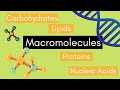
Macromolecules and Their Functions in Living Organisms

Interactive Video
•
Biology, Chemistry, Science
•
6th - 8th Grade
•
Practice Problem
•
Hard

Patricia Brown
FREE Resource
Read more
10 questions
Show all answers
1.
MULTIPLE CHOICE QUESTION
30 sec • 1 pt
What are the four main types of macromolecules found in living organisms?
Enzymes, Hormones, Antibodies, Cells
Water, Salts, Minerals, Vitamins
Sugars, Fats, Oils, DNA
Carbohydrates, Proteins, Lipids, Nucleic Acids
2.
MULTIPLE CHOICE QUESTION
30 sec • 1 pt
Which elements make up carbohydrates in a specific ratio?
Oxygen, Nitrogen, Phosphorus
Hydrogen, Oxygen, Phosphorus
Carbon, Hydrogen, Oxygen
Carbon, Hydrogen, Nitrogen
3.
MULTIPLE CHOICE QUESTION
30 sec • 1 pt
What is the primary function of carbohydrates in the human body?
Act as enzymes
Store genetic information
Build cell membranes
Provide quick energy
4.
MULTIPLE CHOICE QUESTION
30 sec • 1 pt
Which of the following is NOT a characteristic of lipids?
They are always considered macromolecules.
They are great at storing energy.
They are composed of carbon, hydrogen, and oxygen.
They help make cell membranes.
5.
MULTIPLE CHOICE QUESTION
30 sec • 1 pt
What is a common function of lipids in the body?
Catalyze biochemical reactions
Transmit genetic information
Store energy
Provide structural support
6.
MULTIPLE CHOICE QUESTION
30 sec • 1 pt
How many amino acids are used in the human body to build proteins?
20
40
10
30
7.
MULTIPLE CHOICE QUESTION
30 sec • 1 pt
Which protein is found in saliva and helps break down food?
Insulin
Amylase
Hemoglobin
Collagen
Access all questions and much more by creating a free account
Create resources
Host any resource
Get auto-graded reports

Continue with Google

Continue with Email

Continue with Microsoft
or continue with

%20(1).png)
Apple

Others
By signing up, you agree to our Terms of Service & Privacy Policy
Already have an account?


