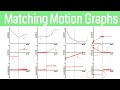
Interpreting Motion Graphs

Interactive Video
•
Physics, Science, Mathematics
•
9th - 12th Grade
•
Practice Problem
•
Hard

Patricia Brown
FREE Resource
Read more
10 questions
Show all answers
1.
MULTIPLE CHOICE QUESTION
30 sec • 1 pt
What does the slope of a position versus time graph represent?
Time
Distance
Velocity
Acceleration
2.
MULTIPLE CHOICE QUESTION
30 sec • 1 pt
If a velocity versus time graph has a constant slope, what does this indicate about acceleration?
Acceleration is increasing
Acceleration is zero
Acceleration is constant
Acceleration is decreasing
3.
MULTIPLE CHOICE QUESTION
30 sec • 1 pt
In a continuous motion graph, what does a transition from a negative slope to zero indicate about velocity?
Velocity is decreasing
Velocity is increasing
Velocity is zero
Velocity remains constant
4.
MULTIPLE CHOICE QUESTION
30 sec • 1 pt
What does a positive acceleration indicate when an object is moving left?
The object is stationary
The object is moving right
The object is slowing down
The object is speeding up
5.
MULTIPLE CHOICE QUESTION
30 sec • 1 pt
In a two-section graph, what does a negative slope in the first section indicate about velocity?
Velocity is zero
Velocity is constant
Velocity is positive
Velocity is negative
6.
MULTIPLE CHOICE QUESTION
30 sec • 1 pt
What happens to velocity when acceleration is negative and velocity is positive?
The object slows down
The object moves backward
The object remains at constant speed
The object speeds up
7.
MULTIPLE CHOICE QUESTION
30 sec • 1 pt
When are an object's velocity and acceleration in the same direction?
When the object is changing direction
When the object is stationary
When the object is speeding up
When the object is slowing down
Access all questions and much more by creating a free account
Create resources
Host any resource
Get auto-graded reports

Continue with Google

Continue with Email

Continue with Classlink

Continue with Clever
or continue with

Microsoft
%20(1).png)
Apple

Others
Already have an account?
Popular Resources on Wayground

15 questions
Fractions on a Number Line

Quiz
•
3rd Grade
20 questions
Equivalent Fractions
Quiz
•
3rd Grade
25 questions
Multiplication Facts
Quiz
•
5th Grade
22 questions
fractions
Quiz
•
3rd Grade
20 questions
Main Idea and Details
Quiz
•
5th Grade
20 questions
Context Clues
Quiz
•
6th Grade
15 questions
Equivalent Fractions
Quiz
•
4th Grade
20 questions
Figurative Language Review
Quiz
•
6th Grade
Discover more resources for Physics
37 questions
Electricity Review
Quiz
•
9th Grade
10 questions
Exit Check 2.4 - 2nd Law Graphs
Quiz
•
9th Grade
10 questions
Exit Check 2.2 - 3rd Law
Quiz
•
9th Grade
10 questions
Exit Check 2.3 - 2nd Law
Quiz
•
9th Grade
10 questions
Exit Check 2.1 - 1st Law
Quiz
•
9th Grade
18 questions
Universal Law of Gravitation

Lesson
•
11th Grade
20 questions
Potential and Kinetic Energy
Quiz
•
9th - 12th Grade
34 questions
Energy Review
Quiz
•
9th - 12th Grade