
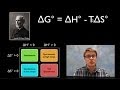
Gibbs Free Energy: Predicting Spontaneity in Chemical Reactions

Interactive Video
•
Chemistry, Science, Physics
•
9th - 12th Grade
•
Practice Problem
•
Hard

Patricia Brown
FREE Resource
Read more
10 questions
Show all answers
1.
MULTIPLE CHOICE QUESTION
30 sec • 1 pt
What does a negative Gibbs Free Energy indicate about a reaction?
The reaction is non-spontaneous.
The reaction is spontaneous.
The reaction is at equilibrium.
The reaction requires energy input.
2.
MULTIPLE CHOICE QUESTION
30 sec • 1 pt
Which two factors primarily contribute to Gibbs Free Energy?
Volume and entropy
Temperature and pressure
Enthalpy and entropy
Pressure and volume
3.
MULTIPLE CHOICE QUESTION
30 sec • 1 pt
In a thermite reaction, why is the reaction considered spontaneous?
Because it requires a catalyst to proceed.
Because the reactants have more energy than the products.
Because the products have more energy than the reactants.
Because it absorbs energy from the surroundings.
4.
MULTIPLE CHOICE QUESTION
30 sec • 1 pt
Why can't enthalpy alone determine the spontaneity of a reaction?
Because pressure changes affect the reaction.
Because entropy also plays a crucial role.
Because temperature is the only factor that matters.
Because volume changes are more significant.
5.
MULTIPLE CHOICE QUESTION
30 sec • 1 pt
What happens to entropy when ice melts into water?
Entropy increases.
Entropy becomes zero.
Entropy remains constant.
Entropy decreases.
6.
MULTIPLE CHOICE QUESTION
30 sec • 1 pt
Under what condition does water spontaneously freeze?
When the temperature is above zero degrees Celsius.
When the temperature is exactly zero degrees Celsius.
When the temperature is below zero degrees Celsius.
When the temperature is above 100 degrees Celsius.
7.
MULTIPLE CHOICE QUESTION
30 sec • 1 pt
What does the Gibbs Free Energy equation help predict?
The speed of a reaction.
The spontaneity of a reaction.
The color change in a reaction.
The pressure change in a reaction.
Access all questions and much more by creating a free account
Create resources
Host any resource
Get auto-graded reports

Continue with Google

Continue with Email

Continue with Classlink

Continue with Clever
or continue with

Microsoft
%20(1).png)
Apple

Others
Already have an account?

