
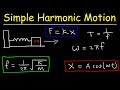
Mastering Simple Harmonic Motion Through Real-World Problem Solving

Interactive Video
•
Physics, Mathematics, Science
•
9th - 12th Grade
•
Practice Problem
•
Hard

Patricia Brown
FREE Resource
Read more
10 questions
Show all answers
1.
MULTIPLE CHOICE QUESTION
30 sec • 1 pt
What is the formula to calculate the period of a simple harmonic oscillator?
Frequency divided by 2π
1 divided by the frequency
2π times the square root of mass divided by the spring constant
2π times the square root of the spring constant divided by mass
2.
MULTIPLE CHOICE QUESTION
30 sec • 1 pt
How is the frequency of a simple harmonic oscillator related to its period?
Frequency is the reciprocal of the period
Frequency is twice the period
Frequency is the square of the period
Frequency is half the period
3.
MULTIPLE CHOICE QUESTION
30 sec • 1 pt
According to Hooke's Law, how do you calculate the spring constant?
Force divided by mass
Force divided by displacement
Displacement divided by force
Mass times acceleration
4.
MULTIPLE CHOICE QUESTION
30 sec • 1 pt
What is the frequency of an oscillator if the spring constant is 1428.6 N/m and the mass is 0.5 kg?
8.51 Hz
3.18 Hz
50 Hz
25 Hz
5.
MULTIPLE CHOICE QUESTION
30 sec • 1 pt
If the spring constant of a spring is quadrupled, what happens to the frequency of vibration?
It remains the same
It quadruples
It halves
It doubles
6.
MULTIPLE CHOICE QUESTION
30 sec • 1 pt
How can you express the relationship between two frequencies when the spring constants are different?
f2/f1 = k2/k1
f2/f1 = k1/k2
f2/f1 = (k2/k1)^2
f2/f1 = sqrt(k2/k1)
7.
MULTIPLE CHOICE QUESTION
30 sec • 1 pt
In the equation x = 0.65 cos(7.35t), what does 0.65 represent?
Phase angle
Angular frequency
Amplitude
Frequency
Access all questions and much more by creating a free account
Create resources
Host any resource
Get auto-graded reports

Continue with Google

Continue with Email

Continue with Microsoft
or continue with

%20(1).png)
Apple

Others
By signing up, you agree to our Terms of Service & Privacy Policy
Already have an account?


