
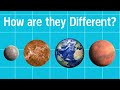
Terrestrial Planets of the Solar System: Exploring Mercury, Venus, Earth, and Mars

Interactive Video
•
Science, Geography, Biology
•
6th - 8th Grade
•
Practice Problem
•
Hard

Patricia Brown
FREE Resource
Read more
10 questions
Show all answers
1.
MULTIPLE CHOICE QUESTION
30 sec • 1 pt
Which planets are classified as terrestrial or inner planets?
Ceres, Vesta, Pallas, Hygiea
Jupiter, Saturn, Uranus, Neptune
Pluto, Eris, Haumea, Makemake
Mercury, Venus, Earth, Mars
2.
MULTIPLE CHOICE QUESTION
30 sec • 1 pt
What is the approximate size of Mercury compared to Earth?
One-third the size of Earth
Twice the size of Earth
Half the size of Earth
Same size as Earth
3.
MULTIPLE CHOICE QUESTION
30 sec • 1 pt
What is the primary composition of Mercury's atmosphere?
Helium and neon
Oxygen, sodium, and hydrogen
Methane and ammonia
Carbon dioxide and nitrogen
4.
MULTIPLE CHOICE QUESTION
30 sec • 1 pt
Why is Venus considered the hottest planet in our solar system?
It has a high concentration of methane
It has active volcanoes
Its thick atmosphere traps heat
It is closest to the Sun
5.
MULTIPLE CHOICE QUESTION
30 sec • 1 pt
What recent discovery on Venus has led scientists to reconsider the possibility of life?
Active volcanoes
Phosphine in the atmosphere
Water in liquid form
Microbial fossils
6.
MULTIPLE CHOICE QUESTION
30 sec • 1 pt
What is the primary composition of Earth's atmosphere?
100% oxygen
96% carbon dioxide, 4% nitrogen
97.5% carbon dioxide, 2.7% nitrogen
78% nitrogen, 21% oxygen
7.
MULTIPLE CHOICE QUESTION
30 sec • 1 pt
How far is Earth from the Sun in astronomical units (AU)?
0.5 AU
1 AU
1.5 AU
2 AU
Access all questions and much more by creating a free account
Create resources
Host any resource
Get auto-graded reports

Continue with Google

Continue with Email

Continue with Microsoft
or continue with

%20(1).png)
Apple

Others
Already have an account?



