
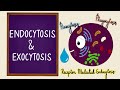
Cell Transport Mechanisms: Endocytosis and Exocytosis Explained

Interactive Video
•
Biology, Science, Chemistry
•
9th - 10th Grade
•
Practice Problem
•
Hard

Patricia Brown
FREE Resource
Read more
10 questions
Show all answers
1.
MULTIPLE CHOICE QUESTION
30 sec • 1 pt
What is the primary function of vesicles in cellular transport?
To synthesize proteins
To transport macromolecules across the cell membrane
To provide energy for the cell
To store genetic information
2.
MULTIPLE CHOICE QUESTION
30 sec • 1 pt
Which type of endocytosis is known as 'cell eating'?
Exocytosis
Phagocytosis
Receptor-mediated endocytosis
Pinocytosis
3.
MULTIPLE CHOICE QUESTION
30 sec • 1 pt
What is the role of lysosomes in phagocytosis?
To synthesize proteins
To digest engulfed material
To transport ions
To provide structural support
4.
MULTIPLE CHOICE QUESTION
30 sec • 1 pt
What structure is primarily involved in receptor-mediated endocytosis?
Mitochondria
Cytoskeleton
Clathrin
Ribosome
5.
MULTIPLE CHOICE QUESTION
30 sec • 1 pt
What is the function of adaptins in receptor-mediated endocytosis?
To bind ligands to receptors
To synthesize ATP
To transport vesicles
To attach receptors to clathrin
6.
MULTIPLE CHOICE QUESTION
30 sec • 1 pt
Which molecule helps in pinching off the vesicle from the membrane during endocytosis?
Dynamin
Actin
Tubulin
Myosin
7.
MULTIPLE CHOICE QUESTION
30 sec • 1 pt
What is the role of the V-snare-T-snare complex in exocytosis?
To degrade cellular waste
To dock vesicles onto the membrane
To provide energy for vesicle movement
To synthesize proteins
Access all questions and much more by creating a free account
Create resources
Host any resource
Get auto-graded reports

Continue with Google

Continue with Email

Continue with Classlink

Continue with Clever
or continue with

Microsoft
%20(1).png)
Apple

Others
Already have an account?

