
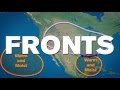
Air Masses and Fronts in Weather Patterns

Interactive Video
•
Science, Geography, Other
•
6th - 8th Grade
•
Practice Problem
•
Medium

Patricia Brown
Used 4+ times
FREE Resource
Read more
10 questions
Show all answers
1.
MULTIPLE CHOICE QUESTION
30 sec • 1 pt
What are air masses primarily characterized by?
Their size
Their temperature
Their similar characteristics
Their speed
2.
MULTIPLE CHOICE QUESTION
30 sec • 1 pt
What is a front in meteorological terms?
A type of precipitation
A weather pattern
A boundary between two air masses
A type of cloud
3.
MULTIPLE CHOICE QUESTION
30 sec • 1 pt
Which type of front is characterized by a warm air mass overtaking a colder one?
Occluded front
Stationary front
Warm front
Cold front
4.
MULTIPLE CHOICE QUESTION
30 sec • 1 pt
What weather conditions are typically associated with warm fronts?
Thunderstorms
Snow
High humidity and drizzle
Clear skies
5.
MULTIPLE CHOICE QUESTION
30 sec • 1 pt
How do cold fronts differ from warm fronts in terms of movement?
They move faster
They move slower
They do not move
They move at the same speed
6.
MULTIPLE CHOICE QUESTION
30 sec • 1 pt
What type of clouds can form due to the rapid upward motion of air in a cold front?
Nimbostratus clouds
Cirrus clouds
Cumulus clouds
Stratus clouds
7.
MULTIPLE CHOICE QUESTION
30 sec • 1 pt
Which direction does the wind generally flow from after a cold front passes?
East
South
West-northwest
North
Access all questions and much more by creating a free account
Create resources
Host any resource
Get auto-graded reports

Continue with Google

Continue with Email

Continue with Classlink

Continue with Clever
or continue with

Microsoft
%20(1).png)
Apple

Others
Already have an account?


