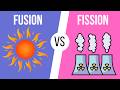
Nuclear Fission Versus Fusion: Key Concepts Explored

Interactive Video
•
Physics, Chemistry, Science
•
9th - 10th Grade
•
Practice Problem
•
Easy

Patricia Brown
Used 1+ times
FREE Resource
Read more
10 questions
Show all answers
1.
MULTIPLE CHOICE QUESTION
30 sec • 1 pt
What is the primary difference between nuclear fission and fusion?
Fission splits atoms, fusion merges them
Fission merges atoms, fusion splits them
Both fission and fusion split atoms
Both fission and fusion merge atoms
2.
MULTIPLE CHOICE QUESTION
30 sec • 1 pt
What element is commonly used in nuclear fission reactions?
Hydrogen
Helium
Uranium-235
Carbon
3.
MULTIPLE CHOICE QUESTION
30 sec • 1 pt
What is a chain reaction in the context of nuclear fission?
A reaction that continues without external input
A reaction that stops after one step
A reaction that produces no energy
A reaction that requires constant energy input
4.
MULTIPLE CHOICE QUESTION
30 sec • 1 pt
Which of the following is a byproduct of nuclear fission?
Helium
Tritium
Iodine-131
Deuterium
5.
MULTIPLE CHOICE QUESTION
30 sec • 1 pt
How is the energy from nuclear fission typically used?
To create new elements
To cool down reactors
To heat steam and turn turbines
To produce hydrogen
6.
MULTIPLE CHOICE QUESTION
30 sec • 1 pt
What is required to initiate nuclear fusion on Earth?
A temperature of 500 degrees Celsius
A temperature of 1 million degrees Celsius
A temperature of 10,000 degrees Celsius
A temperature of 100 million degrees Celsius
7.
MULTIPLE CHOICE QUESTION
30 sec • 1 pt
Which isotopes of hydrogen are involved in nuclear fusion?
Uranium and Plutonium
Deuterium and Tritium
Helium and Neon
Carbon and Oxygen
Access all questions and much more by creating a free account
Create resources
Host any resource
Get auto-graded reports

Continue with Google

Continue with Email

Continue with Classlink

Continue with Clever
or continue with

Microsoft
%20(1).png)
Apple

Others
Already have an account?
Similar Resources on Wayground
Popular Resources on Wayground

15 questions
Fractions on a Number Line

Quiz
•
3rd Grade
20 questions
Equivalent Fractions
Quiz
•
3rd Grade
25 questions
Multiplication Facts
Quiz
•
5th Grade
22 questions
fractions
Quiz
•
3rd Grade
20 questions
Main Idea and Details
Quiz
•
5th Grade
20 questions
Context Clues
Quiz
•
6th Grade
15 questions
Equivalent Fractions
Quiz
•
4th Grade
20 questions
Figurative Language Review
Quiz
•
6th Grade
Discover more resources for Physics
37 questions
Electricity Review
Quiz
•
9th Grade
10 questions
Exit Check 2.4 - 2nd Law Graphs
Quiz
•
9th Grade
10 questions
Exit Check 2.2 - 3rd Law
Quiz
•
9th Grade
10 questions
Exit Check 2.3 - 2nd Law
Quiz
•
9th Grade
10 questions
Exit Check 2.1 - 1st Law
Quiz
•
9th Grade
20 questions
Potential and Kinetic Energy
Quiz
•
9th - 12th Grade
34 questions
Energy Review
Quiz
•
9th - 12th Grade
10 questions
Energy Transformations
Quiz
•
9th Grade