
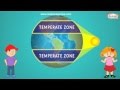
Climate Zones and Weather Patterns Around the World

Interactive Video
•
Science, Geography, Biology
•
3rd - 4th Grade
•
Practice Problem
•
Hard

Patricia Brown
FREE Resource
Read more
10 questions
Show all answers
1.
MULTIPLE CHOICE QUESTION
30 sec • 1 pt
What is the primary reason polar regions experience cold weather throughout the year?
They have a lot of vegetation that cools the area.
They are far from the equator and receive slanted sun rays.
They are located at high altitudes.
They receive direct sunlight all year round.
2.
MULTIPLE CHOICE QUESTION
30 sec • 1 pt
How does weather differ from climate?
Climate changes daily, while weather remains constant.
Weather and climate are the same.
Weather is the short-term atmospheric conditions, while climate is the long-term average.
Weather is the long-term average of climate conditions.
3.
MULTIPLE CHOICE QUESTION
30 sec • 1 pt
Which climate zone is characterized by high temperatures and significant rainfall?
Arctic Zone
Temperate Zone
Polar Zone
Torrid Zone
4.
MULTIPLE CHOICE QUESTION
30 sec • 1 pt
What is a key characteristic of the temperate zone?
It is extremely hot all year round.
It is covered in ice throughout the year.
It has no rainfall.
It experiences moderate weather conditions.
5.
MULTIPLE CHOICE QUESTION
30 sec • 1 pt
Why do areas near the equator have higher temperatures?
They are closer to the sun.
They receive direct sun rays that are concentrated over a smaller area.
They are at a higher altitude.
They have more vegetation.
6.
MULTIPLE CHOICE QUESTION
30 sec • 1 pt
How do slanted sun rays affect the temperature of a region?
They cause more rainfall.
They have no effect on temperature.
They decrease the temperature by spreading heat over a larger area.
They increase the temperature by concentrating heat.
7.
MULTIPLE CHOICE QUESTION
30 sec • 1 pt
What factor, besides sun rays, significantly affects the climate of a region?
Presence of deserts
Proximity to the equator
Elevation or altitude
Amount of rainfall
Access all questions and much more by creating a free account
Create resources
Host any resource
Get auto-graded reports

Continue with Google

Continue with Email

Continue with Classlink

Continue with Clever
or continue with

Microsoft
%20(1).png)
Apple

Others
Already have an account?

