
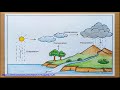
Creating a Diagram of the Water Cycle and Understanding Watersheds and Aquifers

Interactive Video
•
Science, Biology, Geography
•
3rd - 5th Grade
•
Practice Problem
•
Hard

Patricia Brown
FREE Resource
Read more
10 questions
Show all answers
1.
MULTIPLE CHOICE QUESTION
30 sec • 1 pt
What materials are needed to create the water cycle diagram?
A piece of paper, a regular pencil, and a blue pencil
A piece of paper, a ruler, and a red pencil
A notebook, a black pen, and a green pencil
A canvas, a paintbrush, and watercolor paints
2.
MULTIPLE CHOICE QUESTION
30 sec • 1 pt
What is the purpose of drawing a straight line through the center of the page?
To separate the title from the diagram
To divide the watershed and aquifer
To mark the top of the page
To create a border for the diagram
3.
MULTIPLE CHOICE QUESTION
30 sec • 1 pt
What does the blue pencil represent in the diagram?
Air
Land
Sunlight
Water
4.
MULTIPLE CHOICE QUESTION
30 sec • 1 pt
What happens when the sun's rays hit a body of water?
The water evaporates
The water turns into ice
The water becomes salty
The water freezes
5.
MULTIPLE CHOICE QUESTION
30 sec • 1 pt
What is the term for water moving downhill due to gravity?
Evaporation
Condensation
Infiltration
Runoff
6.
MULTIPLE CHOICE QUESTION
30 sec • 1 pt
What symbol is used to represent surface water in the diagram?
G
S
A
W
7.
MULTIPLE CHOICE QUESTION
30 sec • 1 pt
What is the process called when surface water moves into an aquifer?
Evaporation
Recharge
Condensation
Discharge
Access all questions and much more by creating a free account
Create resources
Host any resource
Get auto-graded reports

Continue with Google

Continue with Email

Continue with Microsoft
or continue with

%20(1).png)
Apple

Others
Already have an account?



