
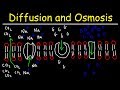
Transport Mechanisms: Exploring Diffusion Osmosis and Cellular Movement

Interactive Video
•
Biology, Science, Chemistry
•
9th - 10th Grade
•
Practice Problem
•
Hard

Patricia Brown
FREE Resource
Read more
10 questions
Show all answers
1.
MULTIPLE CHOICE QUESTION
30 sec • 1 pt
What is the primary characteristic of passive transport?
It moves substances from high to low concentration without energy.
It requires energy to move substances.
It moves substances from low to high concentration.
It involves the use of carrier proteins.
2.
MULTIPLE CHOICE QUESTION
30 sec • 1 pt
Which of the following is an example of passive transport?
Sodium-potassium pump
Endocytosis
Facilitated diffusion
Exocytosis
3.
MULTIPLE CHOICE QUESTION
30 sec • 1 pt
What is required for active transport to occur?
A semi-permeable membrane
Energy in the form of ATP
Carrier proteins
A concentration gradient
4.
MULTIPLE CHOICE QUESTION
30 sec • 1 pt
Which process involves moving substances against their concentration gradient?
Facilitated diffusion
Active transport
Osmosis
Simple diffusion
5.
MULTIPLE CHOICE QUESTION
30 sec • 1 pt
How does facilitated diffusion differ from simple diffusion?
It requires energy.
It only occurs in plant cells.
It involves carrier proteins.
It moves substances from low to high concentration.
6.
MULTIPLE CHOICE QUESTION
30 sec • 1 pt
What role do carrier proteins play in facilitated diffusion?
They block the passage of water.
They assist in moving substances across the membrane.
They create a concentration gradient.
They provide energy for transport.
7.
MULTIPLE CHOICE QUESTION
30 sec • 1 pt
What is osmosis specifically concerned with?
The movement of water
The movement of gases
The movement of proteins
The movement of ions
Access all questions and much more by creating a free account
Create resources
Host any resource
Get auto-graded reports

Continue with Google

Continue with Email

Continue with Classlink

Continue with Clever
or continue with

Microsoft
%20(1).png)
Apple

Others
Already have an account?

