
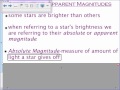
Understanding Star Magnitudes and Brightness

Interactive Video
•
Physics, Science, Other
•
6th - 8th Grade
•
Practice Problem
•
Hard

Patricia Brown
FREE Resource
Read more
10 questions
Show all answers
1.
MULTIPLE CHOICE QUESTION
30 sec • 1 pt
Which constellation is known for its bright stars, especially in its belt?
Cassiopeia
Scorpius
Orion
Ursa Major
2.
MULTIPLE CHOICE QUESTION
30 sec • 1 pt
What does absolute magnitude measure?
The distance of a star from Earth
The true brightness of a star
The temperature of a star
The color of a star
3.
MULTIPLE CHOICE QUESTION
30 sec • 1 pt
How can you remember what absolute magnitude represents?
It's the apparent brightness
It's the true brightness
It's the distance from Earth
It's the absolute distance
4.
MULTIPLE CHOICE QUESTION
30 sec • 1 pt
What does apparent magnitude measure?
The size of a star
The true brightness of a star
The light received on Earth
The age of a star
5.
MULTIPLE CHOICE QUESTION
30 sec • 1 pt
What does the term 'apparent' in apparent magnitude refer to?
The true nature of the star
The perceived brightness from Earth
The distance of the star
The color of the star
6.
MULTIPLE CHOICE QUESTION
30 sec • 1 pt
Why might a star closer to Earth appear brighter than a more luminous star farther away?
Because of its color
Due to its apparent magnitude
Because of its size
Due to its temperature
7.
MULTIPLE CHOICE QUESTION
30 sec • 1 pt
What is the difference between absolute and apparent magnitude?
Absolute magnitude is about distance, apparent is about brightness
Absolute magnitude is about true brightness, apparent is about perceived brightness
Absolute magnitude is about temperature, apparent is about distance
Absolute magnitude is about size, apparent is about color
Access all questions and much more by creating a free account
Create resources
Host any resource
Get auto-graded reports

Continue with Google

Continue with Email

Continue with Microsoft
or continue with

%20(1).png)
Apple

Others
Already have an account?

