
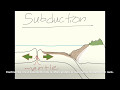
Subduction Zones and Earthquake Dynamics

Interactive Video
•
Science, Geography, Other
•
9th - 12th Grade
•
Practice Problem
•
Hard

Patricia Brown
FREE Resource
Read more
10 questions
Show all answers
1.
MULTIPLE CHOICE QUESTION
30 sec • 1 pt
What is the primary focus of the Cascadia subduction zone discussed in the video?
The formation of new oceanic crust
The hazards it poses to the Pacific Northwest
The creation of mountain ranges
The development of deep-sea trenches
2.
MULTIPLE CHOICE QUESTION
30 sec • 1 pt
What type of crust is typically formed at spreading zones?
New oceanic crust
Old continental crust
New continental crust
Old oceanic crust
3.
MULTIPLE CHOICE QUESTION
30 sec • 1 pt
What happens to oceanic crust when it meets continental crust at a subduction zone?
It rises above the continental crust
It remains stationary
It subducts below the continental crust
It forms a new spreading zone
4.
MULTIPLE CHOICE QUESTION
30 sec • 1 pt
What is an accretionary wedge?
A layer of sediment scraped off at a subduction zone
A type of earthquake fault
A type of volcanic rock
A new oceanic crust formation
5.
MULTIPLE CHOICE QUESTION
30 sec • 1 pt
What geological feature is commonly found near subduction zones?
Rivers
Volcanoes
Deserts
Glaciers
6.
MULTIPLE CHOICE QUESTION
30 sec • 1 pt
How does water affect the melting point of rocks in subduction zones?
It solidifies the rocks
It lowers the melting point
It has no effect
It raises the melting point
7.
MULTIPLE CHOICE QUESTION
30 sec • 1 pt
What is a megathrust earthquake?
An earthquake that occurs in the middle of a tectonic plate
An earthquake caused by volcanic activity
A minor earthquake with little impact
A powerful earthquake at a subduction zone
Access all questions and much more by creating a free account
Create resources
Host any resource
Get auto-graded reports

Continue with Google

Continue with Email

Continue with Classlink

Continue with Clever
or continue with

Microsoft
%20(1).png)
Apple

Others
Already have an account?


