
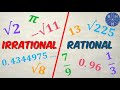
Understanding Irrational Numbers and Their Properties

Interactive Video
•
Mathematics, Science, Other
•
6th - 8th Grade
•
Practice Problem
•
Hard

Patricia Brown
FREE Resource
Read more
10 questions
Show all answers
1.
MULTIPLE CHOICE QUESTION
30 sec • 1 pt
What is the requirement for a number to be considered rational?
It must be a decimal number.
It must be a whole number.
It can be written as a fraction with integer numerator and denominator.
It should be a non-repeating decimal.
2.
MULTIPLE CHOICE QUESTION
30 sec • 1 pt
How can the number 1.73 be expressed as a rational number?
As 173/100
As 17/3
As 1730/1000
As 1/73
3.
MULTIPLE CHOICE QUESTION
30 sec • 1 pt
What is true about all terminating decimals?
They are always rational numbers.
They are irrational numbers.
They cannot be expressed as fractions.
They are always integers.
4.
MULTIPLE CHOICE QUESTION
30 sec • 1 pt
What is a characteristic of non-terminating decimals with repeating patterns?
They cannot be expressed as fractions.
They are always integers.
They can be expressed as fractions.
They are irrational numbers.
5.
MULTIPLE CHOICE QUESTION
30 sec • 1 pt
Which of the following is an example of an irrational number?
2.75
Square root of 2
1/3
0.5
6.
MULTIPLE CHOICE QUESTION
30 sec • 1 pt
What makes a number like pi irrational?
It is a whole number.
It is a repeating decimal.
It is a non-terminating, non-repeating decimal.
It can be expressed as a fraction.
7.
MULTIPLE CHOICE QUESTION
30 sec • 1 pt
Why is the square root of 1.31 considered irrational?
It can be expressed as a fraction.
It is a whole number.
It cannot be expressed as a ratio of two perfect squares.
It is a perfect square.
Access all questions and much more by creating a free account
Create resources
Host any resource
Get auto-graded reports

Continue with Google

Continue with Email

Continue with Classlink

Continue with Clever
or continue with

Microsoft
%20(1).png)
Apple

Others
Already have an account?

