
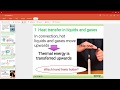
Understanding Convection Principles

Interactive Video
•
Physics, Science, Other
•
6th - 8th Grade
•
Practice Problem
•
Hard

Patricia Brown
FREE Resource
Read more
10 questions
Show all answers
1.
MULTIPLE CHOICE QUESTION
30 sec • 1 pt
What is the primary difference between convection and conduction?
Convection is a slower process than conduction.
Convection can occur in a vacuum, while conduction cannot.
Convection involves the transfer of thermal energy through fluids, while conduction involves direct contact.
Convection occurs in solids, while conduction occurs in liquids and gases.
2.
MULTIPLE CHOICE QUESTION
30 sec • 1 pt
In the context of convection in liquids, what happens to the water near a heat source?
It evaporates immediately.
It remains stationary.
It cools down and sinks.
It heats up and rises.
3.
MULTIPLE CHOICE QUESTION
30 sec • 1 pt
How does convection in gases differ from convection in liquids?
Convection in gases involves the movement of air, while in liquids it involves water.
Gases do not participate in convection.
Convection in gases is slower than in liquids.
Convection in gases does not involve thermal energy transfer.
4.
MULTIPLE CHOICE QUESTION
30 sec • 1 pt
Why does the hand above a flame feel hotter than the one beside it?
Because the air beside the flame is cooler.
Because the flame is hotter at the top.
Because the flame emits more light upwards.
Because thermal energy is transferred upwards.
5.
MULTIPLE CHOICE QUESTION
30 sec • 1 pt
What role does convection play in the functioning of a heater?
It circulates warm air upwards, heating the room.
It cools the air around the heater.
It prevents the heater from overheating.
It directs heat towards the floor.
6.
MULTIPLE CHOICE QUESTION
30 sec • 1 pt
How does an air conditioner utilize convection to cool a room?
By cooling the air and pushing it downwards.
By cooling the air and allowing it to rise.
By heating the air and pushing it downwards.
By heating the air and allowing it to rise.
7.
MULTIPLE CHOICE QUESTION
30 sec • 1 pt
What is a common feature of all examples of convection discussed?
Thermal energy is transferred upwards.
Thermal energy is transferred sideways.
Thermal energy is not transferred.
Thermal energy is transferred downwards.
Access all questions and much more by creating a free account
Create resources
Host any resource
Get auto-graded reports

Continue with Google

Continue with Email

Continue with Microsoft
or continue with

%20(1).png)
Apple

Others
Already have an account?

