
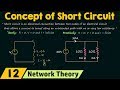
Understanding Short Circuits and Current Behavior

Interactive Video
•
Physics, Science, Mathematics
•
9th - 12th Grade
•
Practice Problem
•
Hard

Patricia Brown
FREE Resource
Read more
10 questions
Show all answers
1.
MULTIPLE CHOICE QUESTION
30 sec • 1 pt
What is a short circuit?
A desired connection between two nodes
An abnormal connection with high resistance
A normal connection in an electrical circuit
An unintended path with low or zero resistance
2.
MULTIPLE CHOICE QUESTION
30 sec • 1 pt
In an ideal short circuit, what is the resistance of the unintended path?
Very high
Equal to the voltage
Zero
Infinite
3.
MULTIPLE CHOICE QUESTION
30 sec • 1 pt
Why is the current infinite in an ideal short circuit?
Because the voltage is zero
Because the resistance is infinite
Because the resistance is zero
Because the voltage is infinite
4.
MULTIPLE CHOICE QUESTION
30 sec • 1 pt
Why is the ideal short circuit not practically possible?
It violates the law of conservation of energy
It requires infinite resistance
It requires infinite voltage
It violates Ohm's Law
5.
MULTIPLE CHOICE QUESTION
30 sec • 1 pt
In a practical short circuit, what is the nature of the current?
Infinite
Finite
Negative
Zero
6.
MULTIPLE CHOICE QUESTION
30 sec • 1 pt
What is the resistance of the unintended path in a practical short circuit?
Zero
Infinite
Very high
Equal to the voltage
7.
MULTIPLE CHOICE QUESTION
30 sec • 1 pt
In the practical example, what is the voltage source used?
100 volts
5 volts
50 volts
10 volts
Access all questions and much more by creating a free account
Create resources
Host any resource
Get auto-graded reports

Continue with Google

Continue with Email

Continue with Microsoft
or continue with

%20(1).png)
Apple

Others
By signing up, you agree to our Terms of Service & Privacy Policy
Already have an account?

