
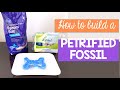
Fossilization and Per Mineralization Concepts

Interactive Video
•
Science, Biology, Chemistry
•
6th - 8th Grade
•
Practice Problem
•
Hard

Patricia Brown
FREE Resource
Read more
10 questions
Show all answers
1.
MULTIPLE CHOICE QUESTION
30 sec • 1 pt
What is a common misconception about fossil formation?
Fossils are always formed by per mineralization.
Fossils are only found in water.
Fossils always contain actual bones or tissues.
Fossils are formed in a few years.
2.
MULTIPLE CHOICE QUESTION
30 sec • 1 pt
What is the process called where minerals replace tissues in fossils?
Per mineralization
Freezing
Mummification
Carbonization
3.
MULTIPLE CHOICE QUESTION
30 sec • 1 pt
Which of the following is NOT needed for the classroom experiment on per mineralization?
A heat lamp
A microscope
A sponge
Epsom salt
4.
MULTIPLE CHOICE QUESTION
30 sec • 1 pt
How much warm water is required for the experiment?
200 milliliters
100 milliliters
150 milliliters
50 milliliters
5.
MULTIPLE CHOICE QUESTION
30 sec • 1 pt
What shape can the sponge be cut into for the experiment?
A star shape
A bone shape
A circle
A triangle
6.
MULTIPLE CHOICE QUESTION
30 sec • 1 pt
What is the purpose of creating a super saturated solution in the experiment?
To dissolve the sponge
To ensure maximum mineral deposition
To evaporate water quickly
To change the color of the sponge
7.
MULTIPLE CHOICE QUESTION
30 sec • 1 pt
Where should the sponge be placed after being saturated with the solution?
In a warm window or under a heat lamp
In a dark cupboard
In a refrigerator
In a freezer
Access all questions and much more by creating a free account
Create resources
Host any resource
Get auto-graded reports

Continue with Google

Continue with Email

Continue with Classlink

Continue with Clever
or continue with

Microsoft
%20(1).png)
Apple

Others
Already have an account?
Popular Resources on Wayground

8 questions
Spartan Way - Classroom Responsible

Quiz
•
9th - 12th Grade
15 questions
Fractions on a Number Line
Quiz
•
3rd Grade
14 questions
Boundaries & Healthy Relationships

Lesson
•
6th - 8th Grade
20 questions
Equivalent Fractions
Quiz
•
3rd Grade
3 questions
Integrity and Your Health
Lesson
•
6th - 8th Grade
25 questions
Multiplication Facts
Quiz
•
5th Grade
9 questions
FOREST Perception
Lesson
•
KG
20 questions
Main Idea and Details
Quiz
•
5th Grade
Discover more resources for Science
22 questions
Phases of the moon
Quiz
•
8th Grade
20 questions
Rocks and The Rock Cycle
Quiz
•
6th Grade
20 questions
Flow of Energy
Quiz
•
7th Grade
20 questions
Waves and Wave Properties
Quiz
•
6th - 8th Grade
8 questions
Amoeba Sister Asexual vs Sexual Reproduction
Interactive video
•
8th Grade
10 questions
Exploring the Rock Cycle: Types and Formation
Interactive video
•
6th - 8th Grade
16 questions
Photosynthesis and Cellular Respiration Review
Quiz
•
7th Grade
20 questions
8th Grade Science STAAR Review
Quiz
•
8th Grade