
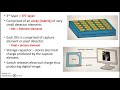
Direct and Indirect Conversion in Radiology

Interactive Video
•
Physics, Science, Computers
•
11th - 12th Grade
•
Practice Problem
•
Hard

Patricia Brown
FREE Resource
Read more
10 questions
Show all answers
1.
MULTIPLE CHOICE QUESTION
30 sec • 1 pt
What are the two main conversion methods in digital radiology?
Static and Dynamic
Linear and Non-linear
Analog and Digital
Direct and Indirect
2.
MULTIPLE CHOICE QUESTION
30 sec • 1 pt
In the indirect conversion method, what is the role of the scintillation layer?
Enhance image contrast
Store electrical charge
Directly convert x-rays into electrons
Convert x-ray photons into light photons
3.
MULTIPLE CHOICE QUESTION
30 sec • 1 pt
Which material is preferred for the scintillation layer due to its ability to form rods?
Cesium Iodide
Amorphous Silicon
Amorphous Selenium
Gadolinium
4.
MULTIPLE CHOICE QUESTION
30 sec • 1 pt
What is the function of the photodiode layer in the TFT system?
Directly convert x-rays into light
Convert light photons into electrical charge
Store x-ray images
Enhance spatial resolution
5.
MULTIPLE CHOICE QUESTION
30 sec • 1 pt
What does a higher fill factor in a pixel array indicate?
Less image contrast
More electrical noise
Higher spatial resolution
Lower spatial resolution
6.
MULTIPLE CHOICE QUESTION
30 sec • 1 pt
What is a key difference between the CCD and TFT systems?
TFT is the oldest indirect conversion system
CCD is coupled directly to the scintillator
TFT uses lenses or fiber optics
CCD uses a photodiode layer
7.
MULTIPLE CHOICE QUESTION
30 sec • 1 pt
What technology was developed by NASA and is used in CCD systems?
Complementary Metal-Oxide-Semiconductor (CMOS)
Amorphous Silicon
Scintillation Layer
Thin Film Transistor
Access all questions and much more by creating a free account
Create resources
Host any resource
Get auto-graded reports

Continue with Google

Continue with Email

Continue with Classlink

Continue with Clever
or continue with

Microsoft
%20(1).png)
Apple

Others
Already have an account?


