
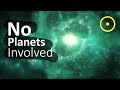
Planetary Nebulae and White Dwarfs

Interactive Video
•
Physics, Chemistry, Science
•
9th - 10th Grade
•
Practice Problem
•
Hard

Patricia Brown
FREE Resource
Read more
8 questions
Show all answers
1.
MULTIPLE CHOICE QUESTION
30 sec • 1 pt
Why did William Herschel name the Saturn nebula a 'planetary nebula'?
As it was discovered near the planet Uranus
Because of its blue-green tint and round shape
Due to its resemblance to the planet Saturn
Because it is related to planets
2.
MULTIPLE CHOICE QUESTION
30 sec • 1 pt
What happens to a low-mass star at the end of its life cycle?
It expands into a red giant and forms a planetary nebula
It becomes a black hole
It explodes as a supernova
It remains unchanged
3.
MULTIPLE CHOICE QUESTION
30 sec • 1 pt
How long does the expanding shell of gas from a planetary nebula last?
About 200,000 years
About 20,000 years
About 2 million years
About 2,000 years
4.
MULTIPLE CHOICE QUESTION
30 sec • 1 pt
What is the significance of planetary nebulae in galaxies?
They create new stars
They enrich the interstellar medium with heavy elements
They absorb light from nearby stars
They prevent the formation of black holes
5.
MULTIPLE CHOICE QUESTION
30 sec • 1 pt
Approximately how many planetary nebulae have been catalogued in our galaxy?
1,800,000
180,000
18,000
1,800
6.
MULTIPLE CHOICE QUESTION
30 sec • 1 pt
What is a notable characteristic of the white dwarf at the center of a planetary nebula?
It emits mostly infrared light
A spoonful of its material can weigh as much as a truck
It is less dense than a neutron star
It is larger than the Earth
7.
MULTIPLE CHOICE QUESTION
30 sec • 1 pt
What type of light do white dwarfs primarily emit?
Infrared light
Visible light
Ultraviolet light
X-rays
Access all questions and much more by creating a free account
Create resources
Host any resource
Get auto-graded reports

Continue with Google

Continue with Email

Continue with Microsoft
or continue with

%20(1).png)
Apple

Others
By signing up, you agree to our Terms of Service & Privacy Policy
Already have an account?

