
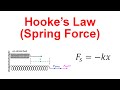
Understanding Hook's Law and Spring Constants

Interactive Video
•
Physics, Science, Mathematics
•
9th - 10th Grade
•
Practice Problem
•
Hard

Patricia Brown
FREE Resource
Read more
10 questions
Show all answers
1.
MULTIPLE CHOICE QUESTION
30 sec • 1 pt
What is Hook's Law primarily concerned with?
The relationship between velocity and time
The relationship between energy and power
The relationship between spring force and displacement
The relationship between force and mass
2.
MULTIPLE CHOICE QUESTION
30 sec • 1 pt
In the equation FS = K * X, what does the variable K represent?
The force applied to the spring
The distance the spring is stretched
The spring constant, indicating stiffness
The gravitational constant
3.
MULTIPLE CHOICE QUESTION
30 sec • 1 pt
Why is there a negative sign in Hook's Law?
To indicate the spring force is in the same direction as the stretch
To show the spring force is opposite to the direction of stretch
To represent the gravitational force
To denote the spring's mass
4.
MULTIPLE CHOICE QUESTION
30 sec • 1 pt
In the first example problem, what is the spring constant given?
200 Newtons per meter
100 Newtons per meter
400 Newtons per meter
300 Newtons per meter
5.
MULTIPLE CHOICE QUESTION
30 sec • 1 pt
What is the mass of the object in the first example problem?
2.1 kg
3.1 kg
4.1 kg
5.1 kg
6.
MULTIPLE CHOICE QUESTION
30 sec • 1 pt
In the second example, what is the constant force applied to the mass?
50 Newtons
75 Newtons
100 Newtons
125 Newtons
7.
MULTIPLE CHOICE QUESTION
30 sec • 1 pt
What is the spring constant in the second example problem?
20 Newtons per meter
15 Newtons per meter
30 Newtons per meter
25 Newtons per meter
Access all questions and much more by creating a free account
Create resources
Host any resource
Get auto-graded reports

Continue with Google

Continue with Email

Continue with Classlink

Continue with Clever
or continue with

Microsoft
%20(1).png)
Apple

Others
Already have an account?


