
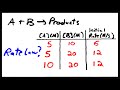
Rate Laws and Reaction Orders

Interactive Video
•
Chemistry, Science, Mathematics
•
10th - 12th Grade
•
Practice Problem
•
Hard

Patricia Brown
FREE Resource
Read more
10 questions
Show all answers
1.
MULTIPLE CHOICE QUESTION
30 sec • 1 pt
What is the general form of a rate law for a reaction with two reactants A and B?
Rate = k[A]^n[B]^m
Rate = k[A]^2[B]^2
Rate = k[A]^m[B]^n
Rate = k[A][B]
2.
MULTIPLE CHOICE QUESTION
30 sec • 1 pt
When determining the order of reaction with respect to A, what condition must be met regarding reactant B?
The concentration of B must be zero.
The concentration of B must increase.
The concentration of B must decrease.
The concentration of B must remain constant.
3.
MULTIPLE CHOICE QUESTION
30 sec • 1 pt
If the concentration of A changes but the initial rate remains constant, what is the order of reaction with respect to A?
First order
Third order
Zero order
Second order
4.
MULTIPLE CHOICE QUESTION
30 sec • 1 pt
What happens to the rate of reaction when the concentration of B is doubled, assuming A is constant?
The rate remains the same.
The rate halves.
The rate triples.
The rate doubles.
5.
MULTIPLE CHOICE QUESTION
30 sec • 1 pt
What is the order of reaction with respect to B if doubling its concentration doubles the rate?
Second order
First order
Third order
Zero order
6.
MULTIPLE CHOICE QUESTION
30 sec • 1 pt
What is the value of m in the rate law expression for this reaction?
3
2
1
0
7.
MULTIPLE CHOICE QUESTION
30 sec • 1 pt
What is the value of n in the rate law expression for this reaction?
0
1
2
3
Access all questions and much more by creating a free account
Create resources
Host any resource
Get auto-graded reports

Continue with Google

Continue with Email

Continue with Classlink

Continue with Clever
or continue with

Microsoft
%20(1).png)
Apple

Others
Already have an account?

