
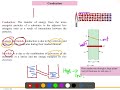
Heat Transfer Concepts and Mechanisms

Interactive Video
•
Physics, Science, Chemistry
•
9th - 10th Grade
•
Practice Problem
•
Hard

Patricia Brown
FREE Resource
Read more
10 questions
Show all answers
1.
MULTIPLE CHOICE QUESTION
30 sec • 1 pt
Which of the following is NOT a mode of heat transfer?
Conduction
Convection
Evaporation
Radiation
2.
MULTIPLE CHOICE QUESTION
30 sec • 1 pt
In which state of matter does conduction primarily involve particle collisions?
Solid
Liquid
Plasma
Gas
3.
MULTIPLE CHOICE QUESTION
30 sec • 1 pt
What is the primary mechanism of heat transfer in gases and liquids?
Collisions and diffusion of particles
Contraction of particles
Expansion of particles
Vibration of particles
4.
MULTIPLE CHOICE QUESTION
30 sec • 1 pt
What is the direction of heat transfer in conduction?
In a circular motion
Randomly
From high to low temperature
From low to high temperature
5.
MULTIPLE CHOICE QUESTION
30 sec • 1 pt
In the pillow passing analogy for conduction, what remains constant?
The position of the particles
The temperature of the particles
The speed of the particles
The size of the particles
6.
MULTIPLE CHOICE QUESTION
30 sec • 1 pt
Which of the following best describes conduction in solids?
Particles collide and move
Particles expand and contract
Particles vibrate in place
Particles move freely
7.
MULTIPLE CHOICE QUESTION
30 sec • 1 pt
According to the video, what happens to particles in a solid when heat is applied?
They stop moving
They vibrate more vigorously
They move to a new position
They change color
Access all questions and much more by creating a free account
Create resources
Host any resource
Get auto-graded reports

Continue with Google

Continue with Email

Continue with Classlink

Continue with Clever
or continue with

Microsoft
%20(1).png)
Apple

Others
Already have an account?

