
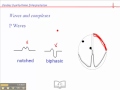
ECG Waveforms and Arrhythmias

Interactive Video
•
Biology, Science, Other
•
11th - 12th Grade
•
Practice Problem
•
Hard

Patricia Brown
FREE Resource
Read more
10 questions
Show all answers
1.
MULTIPLE CHOICE QUESTION
30 sec • 1 pt
What do P waves typically represent in an ECG reading?
Ventricular depolarization
Atrial depolarization
Atrial repolarization
Ventricular repolarization
2.
MULTIPLE CHOICE QUESTION
30 sec • 1 pt
In which leads are P waves usually upright?
Leads V1, V2, and V3
Leads aVR, aVL, and aVF
Leads V4, V5, and V6
Leads I, II, and III
3.
MULTIPLE CHOICE QUESTION
30 sec • 1 pt
What does a notched or biphasic P wave indicate if the rhythm is regular?
Ventricular tachycardia
Atrial fibrillation
Sinus rhythm
Atrial flutter
4.
MULTIPLE CHOICE QUESTION
30 sec • 1 pt
What condition is often associated with changes in P wave morphology?
Right atrial enlargement
Left atrial enlargement
Ventricular hypertrophy
Atrial septal defect
5.
MULTIPLE CHOICE QUESTION
30 sec • 1 pt
What does a premature atrial complex indicate?
A ventricular arrhythmia
A junctional rhythm
An ectopic focus
A regular sinus rhythm
6.
MULTIPLE CHOICE QUESTION
30 sec • 1 pt
What is a key characteristic of a junctional rhythm?
Inverted P waves with a short PR interval
Wide QRS complex
Irregular rhythm
Tall T waves
7.
MULTIPLE CHOICE QUESTION
30 sec • 1 pt
What does the absence of P waves followed by a narrow QRS complex suggest?
Ventricular tachycardia
Sinus bradycardia
Atrial fibrillation
Junctional rhythm
Access all questions and much more by creating a free account
Create resources
Host any resource
Get auto-graded reports

Continue with Google

Continue with Email

Continue with Microsoft
or continue with

%20(1).png)
Apple

Others
Already have an account?

