
Redox Reactions and Activity Series

Interactive Video
•
Chemistry, Science, Physics
•
9th - 10th Grade
•
Practice Problem
•
Hard

Patricia Brown
FREE Resource
Read more
10 questions
Show all answers
1.
MULTIPLE CHOICE QUESTION
30 sec • 1 pt
What does the activity series help us determine about metals?
Their color when heated
Their reactivity and ability to be oxidized
Their ability to conduct electricity
Their melting points
2.
MULTIPLE CHOICE QUESTION
30 sec • 1 pt
Which metals on the activity series are most easily oxidized?
Metals at the bottom of the list
Metals at the top of the list
Metals in the middle of the list
Metals not on the list
3.
MULTIPLE CHOICE QUESTION
30 sec • 1 pt
How does the activity series chart help in predicting reactions with acids?
It lists metals that change color in acid
It ranks metals by their density
It shows which metals will dissolve in water
It indicates which metals can be oxidized by acids
4.
MULTIPLE CHOICE QUESTION
30 sec • 1 pt
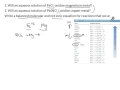
In the example with iron(II) chloride and magnesium, why does the reaction occur?
Iron is more reactive than magnesium
Magnesium is higher on the activity series than iron
Iron is a noble metal
Magnesium is lower on the activity series than iron
5.
MULTIPLE CHOICE QUESTION
30 sec • 1 pt
What is the oxidation state of magnesium in its elemental form?
+2
0
-1
+1
6.
MULTIPLE CHOICE QUESTION
30 sec • 1 pt
Why does no reaction occur between lead(II) nitrate and copper?
Copper is a non-metal
Lead is more reactive than copper
Lead is a gas
Copper is higher on the activity series than lead
7.
MULTIPLE CHOICE QUESTION
30 sec • 1 pt
What does 'NR' stand for in the context of the activity series?
Neutral Reaction
No Reaction
New Reaction
Non-Reactive
Access all questions and much more by creating a free account
Create resources
Host any resource
Get auto-graded reports

Continue with Google

Continue with Email

Continue with Classlink

Continue with Clever
or continue with

Microsoft
%20(1).png)
Apple

Others
Already have an account?

