
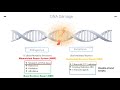
DNA Repair Mechanisms and Functions

Interactive Video
•
Biology, Science, Chemistry
•
10th - 12th Grade
•
Practice Problem
•
Hard

Patricia Brown
FREE Resource
Read more
10 questions
Show all answers
1.
MULTIPLE CHOICE QUESTION
30 sec • 1 pt
What are the two main pathways through which DNA can be damaged?
Endogenous and Exogenous
Internal and External
Primary and Secondary
Direct and Indirect
2.
MULTIPLE CHOICE QUESTION
30 sec • 1 pt
What could happen if DNA damage is not repaired?
Enhanced DNA synthesis
Genomic stability
Genomic instability
Increased cell division
3.
MULTIPLE CHOICE QUESTION
30 sec • 1 pt
Which repair system is responsible for fixing mismatches in DNA bases?
Base Excision Repair
Mismatch Repair System
Nucleotide Excision Repair
Double Strand Break Repair
4.
MULTIPLE CHOICE QUESTION
30 sec • 1 pt
What is the role of MutS protein in the Mismatch Repair System?
It repairs double strand breaks
It removes the incorrect nucleotide
It recognizes the bulge or error
It adds new nucleotides
5.
MULTIPLE CHOICE QUESTION
30 sec • 1 pt
In the Mismatch Repair System, what is the function of MutH protein?
It synthesizes new DNA strands
It detects mismatches
It adds methyl groups
It acts as a scissor to cut the DNA
6.
MULTIPLE CHOICE QUESTION
30 sec • 1 pt
What type of DNA damage does the Base Excision Repair system address?
UV-induced pyrimidine dimers
Double strand breaks
Mismatched bases
Hydrolysis, oxidation, and alkylation
7.
MULTIPLE CHOICE QUESTION
30 sec • 1 pt
Which enzyme removes the incorrect base in the Base Excision Repair system?
DNA polymerase
AP endonuclease
DNA ligase
DNA glycosylase
Access all questions and much more by creating a free account
Create resources
Host any resource
Get auto-graded reports

Continue with Google

Continue with Email

Continue with Microsoft
or continue with

%20(1).png)
Apple

Others
Already have an account?


