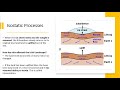
Isostatic Uplift and River Dynamics

Interactive Video
•
Geography, Science, Other
•
9th - 10th Grade
•
Practice Problem
•
Hard

Patricia Brown
FREE Resource
Read more
10 questions
Show all answers
1.
MULTIPLE CHOICE QUESTION
30 sec • 1 pt
What is the primary cause of land rising or falling in isostatic processes?
Earthquakes
Addition or removal of ice sheets
Volcanic eruptions
Tectonic plate movements
2.
MULTIPLE CHOICE QUESTION
30 sec • 1 pt
How do glaciers affect the lithosphere during the Ice Age?
They cause the lithosphere to expand
They have no effect on the lithosphere
They cause the lithosphere to become more rigid
They cause the lithosphere to sink slightly
3.
MULTIPLE CHOICE QUESTION
30 sec • 1 pt
What happens to the lithosphere when the ice sheets melt?
It becomes more dense
It sinks further
It gradually uplifts back to its original state
It remains unchanged
4.
MULTIPLE CHOICE QUESTION
30 sec • 1 pt
What is river rejuvenation?
The process of a river drying up
The river changing its course
The river gaining a new ability to erode
The river becoming shallower
5.
MULTIPLE CHOICE QUESTION
30 sec • 1 pt
What is a nick point in a river?
A point where the river widens
A point where the river dries up
A rapid or small waterfall
A point where the river splits
6.
MULTIPLE CHOICE QUESTION
30 sec • 1 pt
How does isostatic uplift affect the river's speed?
It causes the river to flow in reverse
It has no effect on the river's speed
It slows the river down
It makes the river travel faster
7.
MULTIPLE CHOICE QUESTION
30 sec • 1 pt
What happens to the old river profile after isostatic uplift?
It forms a new river profile
It becomes a new river
It remains unchanged
It disappears completely
Create a free account and access millions of resources
Create resources
Host any resource
Get auto-graded reports

Continue with Google

Continue with Email

Continue with Classlink

Continue with Clever
or continue with

Microsoft
%20(1).png)
Apple

Others
Already have an account?
Similar Resources on Wayground
Popular Resources on Wayground

10 questions
Forest Self-Management

Lesson
•
1st - 5th Grade
25 questions
Multiplication Facts

Quiz
•
5th Grade
30 questions
Thanksgiving Trivia
Quiz
•
9th - 12th Grade
30 questions
Thanksgiving Trivia
Quiz
•
6th Grade
11 questions
Would You Rather - Thanksgiving
Lesson
•
KG - 12th Grade
48 questions
The Eagle Way
Quiz
•
6th Grade
10 questions
Identifying equations
Quiz
•
KG - University
10 questions
Thanksgiving
Lesson
•
5th - 7th Grade