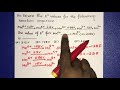
Electrochemistry Concepts and Calculations

Interactive Video
•
Chemistry, Physics, Science
•
11th - 12th Grade
•
Practice Problem
•
Hard

Patricia Brown
FREE Resource
Read more
10 questions
Show all answers
1.
MULTIPLE CHOICE QUESTION
30 sec • 1 pt
What is the relationship between standard Gibbs free energy change (ΔG°) and the number of electrons in a redox reaction?
ΔG° is directly proportional to the number of electrons.
ΔG° is inversely proportional to the number of electrons.
ΔG° is independent of the number of electrons.
ΔG° is equal to the number of electrons.
2.
MULTIPLE CHOICE QUESTION
30 sec • 1 pt
Which constant is used in the calculation of ΔG° for redox reactions?
Faraday constant
Avogadro's constant
Boltzmann constant
Planck's constant
3.
MULTIPLE CHOICE QUESTION
30 sec • 1 pt
What is the significance of the Faraday constant in electrochemistry?
It measures the energy of photons.
It determines the temperature of a reaction.
It relates to the charge of one mole of electrons.
It is used to calculate the speed of light.
4.
MULTIPLE CHOICE QUESTION
30 sec • 1 pt
Which property of ΔG° allows it to be added when combining half-cell reactions?
ΔG° is an intensive property.
ΔG° is a variable property.
ΔG° is a constant property.
ΔG° is an extensive property.
5.
MULTIPLE CHOICE QUESTION
30 sec • 1 pt
In the given problem, what is the initial oxidation state of manganese?
Manganese starts in the +2 oxidation state.
Manganese starts in the +3 oxidation state.
Manganese starts in the +5 oxidation state.
Manganese starts in the +6 oxidation state.
6.
MULTIPLE CHOICE QUESTION
30 sec • 1 pt
How many electrons are involved in the overall reaction from Mn6+ to Mn2+?
4 electrons
3 electrons
2 electrons
1 electron
7.
MULTIPLE CHOICE QUESTION
30 sec • 1 pt
What is the calculated E° cell value for the overall reaction from Mn6+ to Mn2+?
2.66 V
1.66 V
1.26 V
3.66 V
Access all questions and much more by creating a free account
Create resources
Host any resource
Get auto-graded reports

Continue with Google

Continue with Email

Continue with Classlink

Continue with Clever
or continue with

Microsoft
%20(1).png)
Apple

Others
Already have an account?
Popular Resources on Wayground

15 questions
Fractions on a Number Line

Quiz
•
3rd Grade
20 questions
Equivalent Fractions
Quiz
•
3rd Grade
25 questions
Multiplication Facts
Quiz
•
5th Grade
22 questions
fractions
Quiz
•
3rd Grade
20 questions
Main Idea and Details
Quiz
•
5th Grade
20 questions
Context Clues
Quiz
•
6th Grade
15 questions
Equivalent Fractions
Quiz
•
4th Grade
20 questions
Figurative Language Review
Quiz
•
6th Grade
Discover more resources for Chemistry
20 questions
Types of Chemical Reactions
Quiz
•
9th - 12th Grade
20 questions
Energy Transformations
Quiz
•
9th - 12th Grade
17 questions
Reaction Rates
Quiz
•
11th Grade
24 questions
Identifying Types of Chemical Reactions
Quiz
•
10th - 12th Grade
20 questions
Atomic Structure
Quiz
•
10th - 12th Grade
24 questions
Unit 4 Test Practice: Bonding and Properties
Quiz
•
10th - 12th Grade
21 questions
Introduction to Moles

Lesson
•
9th - 12th Grade
24 questions
ERHS Chem - Chapter 7 Chemical Reactions
Quiz
•
10th - 12th Grade