
Empirical Formulas and Percent Composition

Interactive Video
•
Chemistry, Science, Mathematics
•
9th - 12th Grade
•
Practice Problem
•
Hard

Patricia Brown
FREE Resource
Read more
10 questions
Show all answers
1.
MULTIPLE CHOICE QUESTION
30 sec • 1 pt
What is the first step in finding an empirical formula from experimental data?
Balance the chemical equation
Determine the percent composition
Write the chemical equation
Convert masses to moles using molar mass
2.
MULTIPLE CHOICE QUESTION
30 sec • 1 pt
Why do we divide by the smallest number of moles when adjusting empirical formulas?
To simplify the calculation
To balance the equation
To ensure whole number ratios
To find the limiting reactant
3.
MULTIPLE CHOICE QUESTION
30 sec • 1 pt
In the example with carbon and hydrogen, what is the empirical formula derived?
CH2
C2H2
CH
C2H
4.
MULTIPLE CHOICE QUESTION
30 sec • 1 pt
What is the molar mass of carbon used in the example calculation?
1.008
12.011
16.000
14.007
5.
MULTIPLE CHOICE QUESTION
30 sec • 1 pt
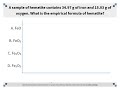
What is the empirical formula of hematite based on the given masses of iron and oxygen?
FeO
FeO2
Fe3O2
Fe2O3
6.
MULTIPLE CHOICE QUESTION
30 sec • 1 pt
Why is it important to maintain the ratio of moles when calculating empirical formulas?
To find the limiting reactant
To balance the equation
To ensure accuracy
To simplify calculations
7.
MULTIPLE CHOICE QUESTION
30 sec • 1 pt
In the hematite example, why is it incorrect to round 1.5 to 2?
It changes the chemical identity
It does not trust the data
It simplifies the calculation
It balances the equation
Access all questions and much more by creating a free account
Create resources
Host any resource
Get auto-graded reports

Continue with Google

Continue with Email

Continue with Microsoft
or continue with

%20(1).png)
Apple

Others
Already have an account?


