
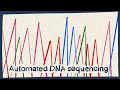
Automated DNA Sequencing Concepts

Interactive Video
•
Biology, Science, Chemistry
•
11th - 12th Grade
•
Practice Problem
•
Hard

Patricia Brown
FREE Resource
Read more
10 questions
Show all answers
1.
MULTIPLE CHOICE QUESTION
30 sec • 1 pt
What is the basis of the automated DNA sequencing method?
It is based on the PCR method.
It is a completely new method with no historical basis.
It is based on the Sanger method.
It is based on the Maxam-Gilbert method.
2.
MULTIPLE CHOICE QUESTION
30 sec • 1 pt
Which component is NOT used in automated DNA sequencing?
ddNTPs
DNA polymerase
Primer
RNA template
3.
MULTIPLE CHOICE QUESTION
30 sec • 1 pt
In automated DNA sequencing, what is labeled with fluorescent dyes?
The DNA polymerase
The template
The primer
The ddNTPs
4.
MULTIPLE CHOICE QUESTION
30 sec • 1 pt
What is the main difference between traditional and automated DNA sequencing methods?
Automated sequencing uses fluorescent labeling.
Traditional sequencing uses fluorescent labeling.
Traditional sequencing does not use any labeling.
Automated sequencing uses radioactive labeling.
5.
MULTIPLE CHOICE QUESTION
30 sec • 1 pt
What is the advantage of mixing ddNTPs in a single container?
It prevents contamination.
It allows for the use of radioactive labeling.
It reduces the time required for sequencing.
It increases the accuracy of sequencing.
6.
MULTIPLE CHOICE QUESTION
30 sec • 1 pt
What is the role of the capillary gel in automated DNA sequencing?
To separate DNA fragments by charge.
To separate DNA fragments by size.
To amplify DNA fragments.
To label DNA fragments.
7.
MULTIPLE CHOICE QUESTION
30 sec • 1 pt
How does the laser contribute to the automated DNA sequencing process?
It amplifies the DNA fragments.
It labels the DNA fragments.
It illuminates the DNA fragments for detection.
It separates the DNA fragments.
Access all questions and much more by creating a free account
Create resources
Host any resource
Get auto-graded reports

Continue with Google

Continue with Email

Continue with Microsoft
or continue with

%20(1).png)
Apple

Others
Already have an account?

