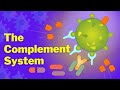
Complement System Pathways and Functions

Interactive Video
•
Biology, Science
•
9th - 10th Grade
•
Practice Problem
•
Hard

Patricia Brown
FREE Resource
Read more
10 questions
Show all answers
1.
MULTIPLE CHOICE QUESTION
30 sec • 1 pt
What is the primary role of the complement system in the body?
To digest food
To regulate blood pressure
To assist in immune responses
To transport oxygen
2.
MULTIPLE CHOICE QUESTION
30 sec • 1 pt
Where are complement proteins primarily produced?
In the liver
In the kidneys
In the lungs
In the heart
3.
MULTIPLE CHOICE QUESTION
30 sec • 1 pt
What triggers the classical pathway of the complement system?
High blood pressure
Presence of water
Antigen-antibody complex
Direct binding to pathogens
4.
MULTIPLE CHOICE QUESTION
30 sec • 1 pt
Which complement protein is the first to bind in the classical pathway?
C3
C5
C1
C9
5.
MULTIPLE CHOICE QUESTION
30 sec • 1 pt
What is the function of the C3a fragment in the complement system?
To split C5
To form the membrane attack complex
To bind to pathogens
To attract phagocytes
6.
MULTIPLE CHOICE QUESTION
30 sec • 1 pt
What is the final outcome of the membrane attack complex formation?
Pathogen replication
Pathogen destruction
Pathogen mutation
Pathogen dormancy
7.
MULTIPLE CHOICE QUESTION
30 sec • 1 pt
How does the alternative pathway differ from the classical pathway?
It does not involve complement proteins
It begins with direct binding of C3 to the pathogen
It requires an antigen-antibody complex
It starts with C1
Access all questions and much more by creating a free account
Create resources
Host any resource
Get auto-graded reports

Continue with Google

Continue with Email

Continue with Classlink

Continue with Clever
or continue with

Microsoft
%20(1).png)
Apple

Others
Already have an account?
Popular Resources on Wayground

15 questions
Fractions on a Number Line

Quiz
•
3rd Grade
20 questions
Equivalent Fractions
Quiz
•
3rd Grade
25 questions
Multiplication Facts
Quiz
•
5th Grade
22 questions
fractions
Quiz
•
3rd Grade
20 questions
Main Idea and Details
Quiz
•
5th Grade
20 questions
Context Clues
Quiz
•
6th Grade
15 questions
Equivalent Fractions
Quiz
•
4th Grade
20 questions
Figurative Language Review
Quiz
•
6th Grade
Discover more resources for Biology
20 questions
Cell Organelles
Quiz
•
10th Grade
20 questions
Cell Organelles
Quiz
•
9th Grade
20 questions
DNA & Protein Synthesis
Quiz
•
9th Grade
7 questions
Amoeba Sisters Dihybrid Cross Punnett Square
Interactive video
•
9th - 12th Grade
25 questions
photosynthesis and cellular respiration
Quiz
•
9th Grade
20 questions
Human Body Systems
Quiz
•
9th Grade
19 questions
Natural Selection
Quiz
•
9th Grade
20 questions
Pedigree Practice
Quiz
•
9th Grade