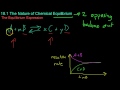
Equilibrium Reactions and Constants

Interactive Video
•
Chemistry, Science, Physics
•
9th - 12th Grade
•
Practice Problem
•
Hard

Patricia Brown
FREE Resource
Read more
10 questions
Show all answers
1.
MULTIPLE CHOICE QUESTION
30 sec • 1 pt
What is the main characteristic of a reversible reaction?
It stops once equilibrium is reached.
It can proceed in both forward and reverse directions.
It only occurs in open systems.
It only proceeds in one direction.
2.
MULTIPLE CHOICE QUESTION
30 sec • 1 pt
When a reaction is said to 'lie to the right', what does it mean?
The reaction is irreversible.
The reaction is at equilibrium.
The products are favored.
The reactants are favored.
3.
MULTIPLE CHOICE QUESTION
30 sec • 1 pt
What happens to the reaction rates of A and B as they form C and D over time?
The reaction rate of A and B increases.
The reaction rate of A and B decreases.
The reaction rate of C and D decreases.
The reaction rate of C and D remains constant.
4.
MULTIPLE CHOICE QUESTION
30 sec • 1 pt
What does a large equilibrium constant (K) indicate about a reaction?
The reaction favors the reactants.
The reaction favors the products.
The reaction is irreversible.
The reaction is slow.
5.
MULTIPLE CHOICE QUESTION
30 sec • 1 pt
How is the equilibrium constant (K) determined?
By observing the color change of the reaction.
Through theoretical calculations.
By measuring the concentrations at equilibrium.
By calculating the reaction rate.
6.
MULTIPLE CHOICE QUESTION
30 sec • 1 pt
In the equilibrium expression, what do the exponents represent?
The temperature of the reaction.
The coefficients from the balanced equation.
The initial concentrations of reactants.
The speed of the reaction.
7.
MULTIPLE CHOICE QUESTION
30 sec • 1 pt
What is the significance of a unitless equilibrium constant?
It acts as a constant of proportionality.
It shows the reaction is at equilibrium.
It means the reaction is spontaneous.
It indicates the reaction is irreversible.
Access all questions and much more by creating a free account
Create resources
Host any resource
Get auto-graded reports

Continue with Google

Continue with Email

Continue with Classlink

Continue with Clever
or continue with

Microsoft
%20(1).png)
Apple

Others
Already have an account?
Popular Resources on Wayground

15 questions
Fractions on a Number Line

Quiz
•
3rd Grade
20 questions
Equivalent Fractions
Quiz
•
3rd Grade
25 questions
Multiplication Facts
Quiz
•
5th Grade
22 questions
fractions
Quiz
•
3rd Grade
20 questions
Main Idea and Details
Quiz
•
5th Grade
20 questions
Context Clues
Quiz
•
6th Grade
15 questions
Equivalent Fractions
Quiz
•
4th Grade
20 questions
Figurative Language Review
Quiz
•
6th Grade
Discover more resources for Chemistry
20 questions
Types of Chemical Reactions
Quiz
•
9th - 12th Grade
20 questions
Energy Transformations
Quiz
•
9th - 12th Grade
20 questions
Periodic Table & Trends
Quiz
•
10th Grade
17 questions
Reaction Rates
Quiz
•
11th Grade
20 questions
Periodic Trends
Quiz
•
10th Grade
24 questions
Identifying Types of Chemical Reactions
Quiz
•
10th - 12th Grade
20 questions
Naming & Writing Chemical Formulas
Quiz
•
10th Grade
20 questions
Atomic Structure
Quiz
•
10th - 12th Grade