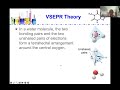
Chemical Bonding and Molecular Geometry

Interactive Video
•
Chemistry, Science, Physics
•
9th - 12th Grade
•
Practice Problem
•
Hard

Patricia Brown
FREE Resource
Read more
10 questions
Show all answers
1.
MULTIPLE CHOICE QUESTION
30 sec • 1 pt
What is a molecular orbital?
An orbital that cannot be occupied by electrons
An orbital that belongs to a single atom
An orbital that only exists in isolated atoms
An orbital that belongs to a molecule as a whole
2.
MULTIPLE CHOICE QUESTION
30 sec • 1 pt
Which type of bond is formed when atomic orbitals overlap end to end?
Sigma bond
Ionic bond
Pi bond
Hydrogen bond
3.
MULTIPLE CHOICE QUESTION
30 sec • 1 pt
Where are the bonding electrons most likely found in a pi bond?
In a linear path along the bond axis
In a circular path around the nuclei
In the sausage-shaped regions above and below the bond axis
Directly between the nuclei
4.
MULTIPLE CHOICE QUESTION
30 sec • 1 pt
What does the VSEPR theory help predict?
The color of molecules
The boiling point of compounds
The molecular shapes based on electron pair repulsion
The atomic mass of elements
5.
MULTIPLE CHOICE QUESTION
30 sec • 1 pt
What is the bond angle in a water molecule according to VSEPR theory?
109.5 degrees
180 degrees
120 degrees
105 degrees
6.
MULTIPLE CHOICE QUESTION
30 sec • 1 pt
What is the molecular shape of carbon dioxide?
Bent
Trigonal planar
Tetrahedral
Linear
7.
MULTIPLE CHOICE QUESTION
30 sec • 1 pt
How do atomic orbitals mix in hybridization?
They mix to form equivalent hybrid orbitals
They remain unchanged
They split into smaller orbitals
They disappear completely
Access all questions and much more by creating a free account
Create resources
Host any resource
Get auto-graded reports

Continue with Google

Continue with Email

Continue with Classlink

Continue with Clever
or continue with

Microsoft
%20(1).png)
Apple

Others
Already have an account?
Similar Resources on Wayground

8 questions
Visualizing a Nucleosome in Virtual Reality
Interactive video
•
11th Grade - University
6 questions
Electron Push and Pull: Inductive Effects Explained
Interactive video
•
10th Grade - University
8 questions
CLEAN : Tara research schooner returns after testing ocean plankton and pollution
Interactive video
•
10th Grade - University
6 questions
CLEAN : Stars attend BAFTA tea party ahead of Golden Globes ceremony
Interactive video
•
10th Grade - University
Popular Resources on Wayground
15 questions
Fractions on a Number Line

Quiz
•
3rd Grade
20 questions
Equivalent Fractions
Quiz
•
3rd Grade
25 questions
Multiplication Facts
Quiz
•
5th Grade
22 questions
fractions
Quiz
•
3rd Grade
20 questions
Main Idea and Details
Quiz
•
5th Grade
20 questions
Context Clues
Quiz
•
6th Grade
15 questions
Equivalent Fractions
Quiz
•
4th Grade
20 questions
Figurative Language Review
Quiz
•
6th Grade
Discover more resources for Chemistry
20 questions
Types of Chemical Reactions
Quiz
•
9th - 12th Grade
20 questions
Energy Transformations
Quiz
•
9th - 12th Grade
20 questions
Periodic Table & Trends
Quiz
•
10th Grade
17 questions
Reaction Rates
Quiz
•
11th Grade
20 questions
Periodic Trends
Quiz
•
10th Grade
24 questions
Identifying Types of Chemical Reactions
Quiz
•
10th - 12th Grade
20 questions
Naming & Writing Chemical Formulas
Quiz
•
10th Grade
20 questions
Atomic Structure
Quiz
•
10th - 12th Grade