
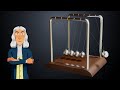
Newton's Cradle: Energy and Momentum

Interactive Video
•
Physics, Science, Mathematics
•
9th - 10th Grade
•
Practice Problem
•
Hard

Patricia Brown
FREE Resource
Read more
10 questions
Show all answers
1.
MULTIPLE CHOICE QUESTION
30 sec • 1 pt
What is a common misconception about the behavior of Newton's Cradle when one ball is released?
All balls remain stationary.
The remaining balls move forward with reduced speed.
The released ball bounces back with the same speed.
All balls move forward at the same speed.
2.
MULTIPLE CHOICE QUESTION
30 sec • 1 pt
Which of Newton's laws is most relevant to understanding the behavior of Newton's Cradle?
Newton's Third Law
Newton's Second Law
Newton's First Law
Newton's Law of Universal Gravitation
3.
MULTIPLE CHOICE QUESTION
30 sec • 1 pt
What does the conservation of momentum principle state?
Momentum is conserved only in inelastic collisions.
Momentum is conserved in the absence of external forces.
Momentum is always increasing.
Momentum is only conserved in elastic collisions.
4.
MULTIPLE CHOICE QUESTION
30 sec • 1 pt
In a two-ball collision in Newton's Cradle, what happens to the first ball after the collision?
It moves upward.
It continues moving with the same speed.
It comes to a rest.
It moves backward.
5.
MULTIPLE CHOICE QUESTION
30 sec • 1 pt
Why do people often incorrectly predict that all four balls will move forward after a collision?
They forget about gravity.
They assume the balls are glued together.
They think the balls are of different masses.
They ignore air resistance.
6.
MULTIPLE CHOICE QUESTION
30 sec • 1 pt
What happens to the momentum and energy transfer in Newton's Cradle?
It occurs between the first and second balls, then continues sequentially.
It occurs between all balls simultaneously.
It occurs only between the first and last balls.
It occurs only between the first two balls.
7.
MULTIPLE CHOICE QUESTION
30 sec • 1 pt
What is the result of applying conservation principles to the motion of balls in Newton's Cradle?
All balls stop moving.
All balls move in random directions.
The last ball moves with the velocity of the first ball.
The first ball moves backward.
Access all questions and much more by creating a free account
Create resources
Host any resource
Get auto-graded reports

Continue with Google

Continue with Email

Continue with Classlink

Continue with Clever
or continue with

Microsoft
%20(1).png)
Apple

Others
Already have an account?


