
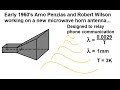
Cosmic Background Radiation Discoveries

Interactive Video
•
Physics, Science, History
•
9th - 12th Grade
•
Practice Problem
•
Hard

Patricia Brown
FREE Resource
Read more
10 questions
Show all answers
1.
MULTIPLE CHOICE QUESTION
30 sec • 1 pt
What was the primary task assigned to Arno Penzias and Robert Wilson at Bell Laboratories?
To design a new communication system for military use.
To study the effects of cosmic radiation on electronic devices.
To develop a new type of telescope for astronomical observations.
To create a microwave horn antenna for satellite communications.
2.
MULTIPLE CHOICE QUESTION
30 sec • 1 pt
What unexpected issue did Penzias and Wilson encounter during their antenna tests?
A software error in their data analysis program.
A malfunction in the antenna's electronic components.
Interference from nearby radio stations.
Persistent noise radiation that they couldn't eliminate.
3.
MULTIPLE CHOICE QUESTION
30 sec • 1 pt
What did Penzias and Wilson initially suspect was causing the noise interference?
Interference from other satellites.
A fault in the antenna's design.
Pigeon droppings inside the antenna.
Cosmic background radiation.
4.
MULTIPLE CHOICE QUESTION
30 sec • 1 pt
Which scientists' work did Penzias and Wilson learn about that related to their findings?
Stephen Hawking and Carl Sagan.
Albert Einstein and Niels Bohr.
Isaac Newton and Galileo Galilei.
Robert Dickey and P.J. Peebles.
5.
MULTIPLE CHOICE QUESTION
30 sec • 1 pt
What did the cosmic background radiation indicate about the early universe?
It was extremely cold and static.
It was filled with high-energy radiation.
It was devoid of any significant radiation.
It was primarily composed of dark matter.
6.
MULTIPLE CHOICE QUESTION
30 sec • 1 pt
What was the approximate wavelength of the radiation detected by Penzias and Wilson?
One kilometer.
One meter.
One millimeter.
One centimeter.
7.
MULTIPLE CHOICE QUESTION
30 sec • 1 pt
What temperature did the cosmic background radiation correspond to?
0.3 degrees Kelvin.
30 degrees Kelvin.
3 degrees Kelvin.
300 degrees Kelvin.
Access all questions and much more by creating a free account
Create resources
Host any resource
Get auto-graded reports

Continue with Google

Continue with Email

Continue with Classlink

Continue with Clever
or continue with

Microsoft
%20(1).png)
Apple

Others
Already have an account?

