
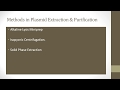
Plasmid Extraction Techniques and Applications

Interactive Video
•
Biology, Science, Chemistry
•
11th - 12th Grade
•
Practice Problem
•
Hard

Patricia Brown
FREE Resource
Read more
10 questions
Show all answers
1.
MULTIPLE CHOICE QUESTION
30 sec • 1 pt
What is one of the primary applications of plasmid extraction?
Metal extraction
Water purification
Food preservation
Genetic engineering
2.
MULTIPLE CHOICE QUESTION
30 sec • 1 pt
Which method is commonly used for plasmid purification but not suitable for plasmids larger than 20,000 bases?
Isopycnic centrifugation
Alkaline lysis
Gel electrophoresis
Solid-phase extraction
3.
MULTIPLE CHOICE QUESTION
30 sec • 1 pt
What is the role of NaOH in the alkaline lysis method?
To bind plasmid DNA
To precipitate proteins
To lyse bacterial cells
To neutralize the solution
4.
MULTIPLE CHOICE QUESTION
30 sec • 1 pt
Which solution in the alkaline lysis method contains glucose, EDTA, and tris-HCl?
Solution 1
Solution 2
Solution 3
Solution 4
5.
MULTIPLE CHOICE QUESTION
30 sec • 1 pt
What is the purpose of using a chromatographic matrix in solid-phase extraction?
To enhance solution viscosity
To precipitate proteins
To separate plasmid DNA
To lyse bacterial cells
6.
MULTIPLE CHOICE QUESTION
30 sec • 1 pt
Which method involves the use of a gradient and centrifugation to extract macromolecules?
Gel electrophoresis
Solid-phase extraction
Alkaline lysis
Isopycnic centrifugation
7.
MULTIPLE CHOICE QUESTION
30 sec • 1 pt
What are lipopolysaccharides, and why must they be removed from plasmids?
They are proteins that stabilize DNA; they must be removed to prevent degradation.
They are sugars that enhance plasmid function; they must be removed to increase efficiency.
They are components of the bacterial cell wall; they must be removed to prevent immune response.
They are lipids that protect plasmids; they must be removed to allow for proper cloning.
Access all questions and much more by creating a free account
Create resources
Host any resource
Get auto-graded reports

Continue with Google

Continue with Email

Continue with Classlink

Continue with Clever
or continue with

Microsoft
%20(1).png)
Apple

Others
Already have an account?
Similar Resources on Wayground

6 questions
The Sun: A Closer Look at Our Nearest Star
Interactive video
•
KG - University
6 questions
The Latest From Mars: Day 2
Interactive video
•
11th Grade - University
6 questions
Could Humans Ever Breathe Water?
Interactive video
•
11th Grade - University
8 questions
GCSE Secondary Maths Age 13-17 - Ratio, Proportion & Rates of Change: Ratio - Explained
Interactive video
•
10th - 12th Grade
8 questions
Run, sail or hide? How to survive the destruction of Pompeii | Gary Devore
Interactive video
•
KG - University
8 questions
The Strange, Smelly Science of Decomposing Bodies
Interactive video
•
11th Grade - University
Popular Resources on Wayground
15 questions
Fractions on a Number Line

Quiz
•
3rd Grade
10 questions
Probability Practice
Quiz
•
4th Grade
15 questions
Probability on Number LIne
Quiz
•
4th Grade
20 questions
Equivalent Fractions
Quiz
•
3rd Grade
25 questions
Multiplication Facts
Quiz
•
5th Grade
22 questions
fractions
Quiz
•
3rd Grade
6 questions
Appropriate Chromebook Usage

Lesson
•
7th Grade
10 questions
Greek Bases tele and phon
Quiz
•
6th - 8th Grade
Discover more resources for Biology
20 questions
Food Chains and Food Webs
Quiz
•
7th - 12th Grade
25 questions
Mock STAAR Review 2
Quiz
•
12th Grade
5 questions
Inherited and Acquired Traits of Animals
Interactive video
•
4th Grade - University
48 questions
Unit 8B: Plant System
Quiz
•
9th - 12th Grade
36 questions
DNA & Protein Synthesis 3.1.1-3.1.3
Quiz
•
9th - 12th Grade
44 questions
Population Variation and Biotechnology
Quiz
•
9th - 12th Grade
30 questions
DNA & Central Dogma Test Review
Quiz
•
9th - 12th Grade
20 questions
Quarterly 3 Review Quizziz
Quiz
•
9th - 12th Grade