
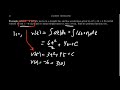
Antiderivatives and Initial Value Problems

Interactive Video
•
Mathematics, Physics, Science
•
11th - 12th Grade
•
Practice Problem
•
Hard

Patricia Brown
FREE Resource
Read more
10 questions
Show all answers
1.
MULTIPLE CHOICE QUESTION
30 sec • 1 pt
What is the primary goal when solving an initial value problem?
To find the general antiderivative
To find a particular antiderivative
To determine the speed of an object
To calculate the area under a curve
2.
MULTIPLE CHOICE QUESTION
30 sec • 1 pt
In the analogy provided, why is knowing only the speed of a car insufficient?
Because speed does not indicate direction
Because speed alone does not tell the current location
Because speed is irrelevant to travel time
Because speed cannot be measured accurately
3.
MULTIPLE CHOICE QUESTION
30 sec • 1 pt
What is the antiderivative of 6x^2 + 4?
3x^3 + 4x + C
x^3 + 4x + C
2x^3 + 4x + C
6x^3 + 4x + C
4.
MULTIPLE CHOICE QUESTION
30 sec • 1 pt
What initial condition is used to solve for the constant C in the function f(x) = 2x^3 + 4x + C?
f(2) = 2
f(3) = 3
f(1) = 1
f(0) = 0
5.
MULTIPLE CHOICE QUESTION
30 sec • 1 pt
What is the initial velocity of the particle in the new example?
0 cm/s
9 cm/s
-6 cm/s
6 cm/s
6.
MULTIPLE CHOICE QUESTION
30 sec • 1 pt
How is velocity related to acceleration in the context of antiderivatives?
Velocity is unrelated to acceleration
Velocity is the second derivative of acceleration
Velocity is the antiderivative of acceleration
Velocity is the derivative of acceleration
7.
MULTIPLE CHOICE QUESTION
30 sec • 1 pt
What is the velocity function derived from the acceleration a(t) = 6t + 4?
3t^2 + 4t - 6
t^2 + 4t + C
6t^2 + 4t + C
3t^2 + 4t + C
Access all questions and much more by creating a free account
Create resources
Host any resource
Get auto-graded reports

Continue with Google

Continue with Email

Continue with Classlink

Continue with Clever
or continue with

Microsoft
%20(1).png)
Apple

Others
Already have an account?
Popular Resources on Wayground

15 questions
Fractions on a Number Line

Quiz
•
3rd Grade
20 questions
Equivalent Fractions
Quiz
•
3rd Grade
25 questions
Multiplication Facts
Quiz
•
5th Grade
29 questions
Alg. 1 Section 5.1 Coordinate Plane
Quiz
•
9th Grade
22 questions
fractions
Quiz
•
3rd Grade
11 questions
FOREST Effective communication

Lesson
•
KG
20 questions
Main Idea and Details
Quiz
•
5th Grade
20 questions
Context Clues
Quiz
•
6th Grade
Discover more resources for Mathematics
20 questions
SSS/SAS
Quiz
•
9th - 12th Grade
14 questions
Making Inferences From Samples
Quiz
•
7th - 12th Grade
23 questions
CCG - CH8 Polygon angles and area Review
Quiz
•
9th - 12th Grade
16 questions
Properties of Quadrilaterals
Quiz
•
11th Grade
20 questions
Domain and Range Spiral Review
Quiz
•
9th - 12th Grade
10 questions
Dividing a polynomial by a monomial
Quiz
•
10th - 12th Grade
16 questions
Explore Triangle Congruence Theorems
Quiz
•
9th - 12th Grade
17 questions
Interpreting Graphs Of Functions
Quiz
•
8th - 12th Grade