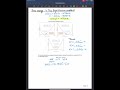
Gibbs Free Energy and Equilibrium Concepts

Interactive Video
•
Chemistry, Science, Physics
•
11th - 12th Grade
•
Practice Problem
•
Hard

Patricia Brown
FREE Resource
Read more
10 questions
Show all answers
1.
MULTIPLE CHOICE QUESTION
30 sec • 1 pt
What is the relationship between free energy and the equilibrium constant?
Free energy is only relevant at non-standard conditions.
Free energy is independent of the equilibrium constant.
Free energy is always positive when the equilibrium constant is greater than one.
Free energy is related to the equilibrium constant through the equation ΔG = -RT ln(K).
2.
MULTIPLE CHOICE QUESTION
30 sec • 1 pt
Under what condition is the Gibbs free energy of a reaction zero?
When the equilibrium constant is less than one.
When the reaction is at non-standard conditions.
When the reaction is at equilibrium.
When the temperature is above 298 K.
3.
MULTIPLE CHOICE QUESTION
30 sec • 1 pt
What does a large equilibrium constant (K > 1) indicate about a reaction?
The reaction is at equilibrium.
The reaction is spontaneous in the forward direction.
The reaction has more reactants than products.
The reaction is non-spontaneous in the forward direction.
4.
MULTIPLE CHOICE QUESTION
30 sec • 1 pt
What does a negative Gibbs free energy under standard conditions indicate?
The reaction has more reactants than products.
The reaction is non-spontaneous.
The reaction is at equilibrium.
The reaction is spontaneous.
5.
MULTIPLE CHOICE QUESTION
30 sec • 1 pt
What happens to the Gibbs free energy when K equals 1?
It becomes positive.
It becomes negative.
It becomes zero.
It becomes undefined.
6.
MULTIPLE CHOICE QUESTION
30 sec • 1 pt
In the example problem, what is the calculated equilibrium constant at 25°C?
3.09
2.80
0.50
1.00
7.
MULTIPLE CHOICE QUESTION
30 sec • 1 pt
How does the equilibrium constant change with temperature?
It remains constant regardless of temperature changes.
It changes depending on the reaction's enthalpy and entropy.
It increases as temperature increases.
It decreases as temperature increases.
Access all questions and much more by creating a free account
Create resources
Host any resource
Get auto-graded reports

Continue with Google

Continue with Email

Continue with Classlink

Continue with Clever
or continue with

Microsoft
%20(1).png)
Apple

Others
Already have an account?
Popular Resources on Wayground

15 questions
Fractions on a Number Line

Quiz
•
3rd Grade
20 questions
Equivalent Fractions
Quiz
•
3rd Grade
25 questions
Multiplication Facts
Quiz
•
5th Grade
22 questions
fractions
Quiz
•
3rd Grade
20 questions
Main Idea and Details
Quiz
•
5th Grade
20 questions
Context Clues
Quiz
•
6th Grade
15 questions
Equivalent Fractions
Quiz
•
4th Grade
20 questions
Figurative Language Review
Quiz
•
6th Grade
Discover more resources for Chemistry
20 questions
Types of Chemical Reactions
Quiz
•
9th - 12th Grade
20 questions
Energy Transformations
Quiz
•
9th - 12th Grade
17 questions
Reaction Rates
Quiz
•
11th Grade
24 questions
Identifying Types of Chemical Reactions
Quiz
•
10th - 12th Grade
20 questions
Atomic Structure
Quiz
•
10th - 12th Grade
24 questions
Unit 4 Test Practice: Bonding and Properties
Quiz
•
10th - 12th Grade
21 questions
Introduction to Moles

Lesson
•
9th - 12th Grade
24 questions
ERHS Chem - Chapter 7 Chemical Reactions
Quiz
•
10th - 12th Grade