
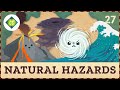
Geography and Resilience Concepts

Interactive Video
•
Geography, Science, Social Studies
•
9th - 12th Grade
•
Practice Problem
•
Hard

Patricia Brown
FREE Resource
Read more
10 questions
Show all answers
1.
MULTIPLE CHOICE QUESTION
30 sec • 1 pt
Which natural hazard is commonly associated with the Pacific Ring of Fire?
Hurricanes
Tornadoes
Volcanoes
Blizzards
2.
MULTIPLE CHOICE QUESTION
30 sec • 1 pt
What distinguishes a natural event from a natural hazard?
The duration of the event
The impact on human systems
The frequency of the event
The location of the event
3.
MULTIPLE CHOICE QUESTION
30 sec • 1 pt
Why might a mild flood in a city be considered more hazardous than severe flooding in a remote area?
Cities have more advanced warning systems
Remote areas have more resources
Remote areas are better prepared
Cities have higher population density
4.
MULTIPLE CHOICE QUESTION
30 sec • 1 pt
What factor is NOT typically considered when evaluating the magnitude of a natural hazard?
Duration of the event
Color of the sky
Intensity of a windstorm
Height of a flood
5.
MULTIPLE CHOICE QUESTION
30 sec • 1 pt
How did the Onge tribe survive the 2004 tsunami?
By building strong shelters
By following their oral traditions
By evacuating to another island
By using modern technology
6.
MULTIPLE CHOICE QUESTION
30 sec • 1 pt
What is a key aspect of resilience in disaster risk management?
Ignoring local knowledge
Focusing solely on prevention
Relying only on technology
Shifting focus from vulnerability to recovery
7.
MULTIPLE CHOICE QUESTION
30 sec • 1 pt
Which architectural feature in Nepal helps with earthquake resilience?
Skyscrapers
Mixed timber and masonry construction
Steel structures
Glass buildings
Access all questions and much more by creating a free account
Create resources
Host any resource
Get auto-graded reports

Continue with Google

Continue with Email

Continue with Classlink

Continue with Clever
or continue with

Microsoft
%20(1).png)
Apple

Others
Already have an account?


