
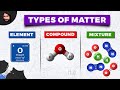
Characteristics of Mixtures and Changes

Interactive Video
•
Chemistry, Science, Biology
•
9th - 10th Grade
•
Practice Problem
•
Hard

Patricia Brown
FREE Resource
Read more
10 questions
Show all answers
1.
MULTIPLE CHOICE QUESTION
30 sec • 1 pt
Which phase of matter has a fixed shape and volume?
Liquid
Solid
Plasma
Gas
2.
MULTIPLE CHOICE QUESTION
30 sec • 1 pt
What happens to the particles in a liquid compared to a solid?
They are touching but move fluidly
They are not touching and move randomly
They move freely and are far apart
They are fixed in place
3.
MULTIPLE CHOICE QUESTION
30 sec • 1 pt
What is a key characteristic of a chemical change?
The substance changes phase
The chemical composition remains the same
New chemical bonds are formed
The substance retains its original properties
4.
MULTIPLE CHOICE QUESTION
30 sec • 1 pt
When ice melts into water, what type of change is occurring?
Physical change
No change
Chemical change
Nuclear change
5.
MULTIPLE CHOICE QUESTION
30 sec • 1 pt
Which of the following is a pure substance?
Salt water
Air
Water
Sand
6.
MULTIPLE CHOICE QUESTION
30 sec • 1 pt
What is a compound?
A single element
A mixture of elements
A substance made of two or more elements chemically bonded
A homogeneous mixture
7.
MULTIPLE CHOICE QUESTION
30 sec • 1 pt
How can a mixture be separated?
By changing its phase
By physical processes
By nuclear reactions
By chemical reactions
Access all questions and much more by creating a free account
Create resources
Host any resource
Get auto-graded reports

Continue with Google

Continue with Email

Continue with Classlink

Continue with Clever
or continue with

Microsoft
%20(1).png)
Apple

Others
Already have an account?

