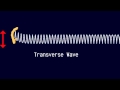
Transverse and Longitudinal Waves

Interactive Video
•
Physics, Science, Other
•
6th - 8th Grade
•
Practice Problem
•
Hard

Patricia Brown
FREE Resource
Read more
5 questions
Show all answers
1.
MULTIPLE CHOICE QUESTION
30 sec • 1 pt
What is the direction of the disturbance in a longitudinal wave relative to the wave's travel direction?
Circular
Perpendicular
Parallel
Diagonal
2.
MULTIPLE CHOICE QUESTION
30 sec • 1 pt
What is another name for longitudinal waves?
Shear waves
Torsional waves
Surface waves
Compression waves
3.
MULTIPLE CHOICE QUESTION
30 sec • 1 pt
In a transverse wave, how does the disturbance move in relation to the wave's direction?
In a spiral
Parallel
Randomly
Perpendicular
4.
MULTIPLE CHOICE QUESTION
30 sec • 1 pt
Which type of wave is characterized by disturbances that are perpendicular to the direction of wave travel?
Standing wave
Transverse wave
Longitudinal wave
Compression wave
5.
MULTIPLE CHOICE QUESTION
30 sec • 1 pt
Which of the following is NOT a characteristic of transverse waves?
Disturbance moves up and down
Commonly seen in electromagnetic waves
Also known as compression waves
Disturbance is perpendicular to wave direction
Access all questions and much more by creating a free account
Create resources
Host any resource
Get auto-graded reports

Continue with Google

Continue with Email

Continue with Classlink

Continue with Clever
or continue with

Microsoft
%20(1).png)
Apple

Others
Already have an account?
Similar Resources on Wayground

11 questions
Kuis Getaran, Gelombang, dan Bunyi
Interactive video
•
6th - 8th Grade
6 questions
Understanding Color
Interactive video
•
6th - 8th Grade
6 questions
Understanding Waves
Interactive video
•
6th - 8th Grade
6 questions
Understanding Tsunamis
Interactive video
•
6th - 7th Grade
6 questions
Understanding Earth's Layers
Interactive video
•
6th - 7th Grade
8 questions
Types of Rocks and Their Formation
Interactive video
•
6th - 8th Grade
6 questions
Mega Chess Rules Quiz
Interactive video
•
6th - 8th Grade
11 questions
Exploring Plate Boundaries and Fault Dynamics
Interactive video
•
6th - 8th Grade
Popular Resources on Wayground
5 questions
This is not a...winter edition (Drawing game)

Quiz
•
1st - 5th Grade
25 questions
Multiplication Facts
Quiz
•
5th Grade
10 questions
Identify Iconic Christmas Movie Scenes
Interactive video
•
6th - 10th Grade
20 questions
Christmas Trivia
Quiz
•
6th - 8th Grade
18 questions
Kids Christmas Trivia
Quiz
•
KG - 5th Grade
11 questions
How well do you know your Christmas Characters?

Lesson
•
3rd Grade
14 questions
Christmas Trivia
Quiz
•
5th Grade
20 questions
How the Grinch Stole Christmas
Quiz
•
5th Grade