
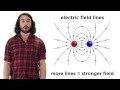
Electric Forces and Fields Concepts

Interactive Video
•
Physics, Chemistry, Science
•
9th - 10th Grade
•
Practice Problem
•
Hard

Patricia Brown
FREE Resource
Read more
10 questions
Show all answers
1.
MULTIPLE CHOICE QUESTION
30 sec • 1 pt
What happens when you rub a balloon on your hair?
The balloon remains neutral.
The balloon loses its charge.
The balloon becomes negatively charged.
The balloon becomes positively charged.
2.
MULTIPLE CHOICE QUESTION
30 sec • 1 pt
Which subatomic particle is negatively charged?
Proton
Electron
Photon
Neutron
3.
MULTIPLE CHOICE QUESTION
30 sec • 1 pt
What is the fundamental charge of an electron?
9.8 x 10^-19 coulombs
1.6 x 10^19 coulombs
1.6 x 10^-19 coulombs
9.8 x 10^19 coulombs
4.
MULTIPLE CHOICE QUESTION
30 sec • 1 pt
What does Coulomb's law describe?
The speed of light.
The force between two charges.
The force between two masses.
The energy of a photon.
5.
MULTIPLE CHOICE QUESTION
30 sec • 1 pt
How does the electric force compare to gravitational force?
Both forces are equal.
Electric force is weaker.
Electric force is stronger.
Electric force is non-existent.
6.
MULTIPLE CHOICE QUESTION
30 sec • 1 pt
What is the role of an electric field?
To propagate gravitational force.
To propagate electric force.
To create magnetic fields.
To neutralize charges.
7.
MULTIPLE CHOICE QUESTION
30 sec • 1 pt
What do electric field lines represent?
The direction of electric force.
The path of electrons.
The strength of magnetic fields.
The flow of current.
Access all questions and much more by creating a free account
Create resources
Host any resource
Get auto-graded reports

Continue with Google

Continue with Email

Continue with Microsoft
or continue with

%20(1).png)
Apple

Others
Already have an account?


