
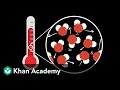
Understanding Thermal Energy Concepts

Interactive Video
•
Physics, Science, Chemistry
•
9th - 12th Grade
•
Practice Problem
•
Hard

Patricia Brown
FREE Resource
Read more
10 questions
Show all answers
1.
MULTIPLE CHOICE QUESTION
30 sec • 1 pt
Why does the vessel with less water boil faster?
Its temperature rises quicker.
It has more thermal energy.
It receives more heat energy.
It has a higher density.
2.
MULTIPLE CHOICE QUESTION
30 sec • 1 pt
What is thermal energy?
The energy required to change the state of a substance.
The energy stored in chemical bonds.
The sum of kinetic energy of all particles.
The potential energy of particles in a solid.
3.
MULTIPLE CHOICE QUESTION
30 sec • 1 pt
How does thermal energy differ in solids compared to liquids?
In liquids, particles are locked in place.
In solids, thermal energy is mostly due to vibrational motion.
In liquids, thermal energy is due to potential energy.
In solids, particles can move freely.
4.
MULTIPLE CHOICE QUESTION
30 sec • 1 pt
What does temperature measure?
The average kinetic energy of particles.
The total energy of all particles.
The potential energy of a system.
The heat energy transferred to a system.
5.
MULTIPLE CHOICE QUESTION
30 sec • 1 pt
How can two bodies have the same temperature but different thermal energies?
They are at different altitudes.
They have different numbers of particles.
They have different densities.
They are made of different materials.
6.
MULTIPLE CHOICE QUESTION
30 sec • 1 pt
What is heat energy?
The energy lost during a phase change.
The energy transferred between systems.
The energy stored in a system.
The energy required to raise temperature.
7.
MULTIPLE CHOICE QUESTION
30 sec • 1 pt
Which method of thermal energy transfer does not require matter?
Convection
Radiation
Evaporation
Conduction
Access all questions and much more by creating a free account
Create resources
Host any resource
Get auto-graded reports

Continue with Google

Continue with Email

Continue with Classlink

Continue with Clever
or continue with

Microsoft
%20(1).png)
Apple

Others
Already have an account?
Similar Resources on Wayground

6 questions
Weather Around Us: Summing Up
Interactive video
•
10th - 12th Grade
6 questions
Living Green - Episode 30 - World's Largest Rotating Christmas Star
Interactive video
•
KG - University
11 questions
Fundamentals of Chemistry Concepts
Interactive video
•
9th - 12th Grade
6 questions
Series Circuits: Resistance, Current, and Potential Difference
Interactive video
•
10th Grade - University
6 questions
History of Wind Power
Interactive video
•
9th - 12th Grade
6 questions
Basic Water Cooled CHiller
Interactive video
•
KG - University
9 questions
Understanding Sleep and Its Impact on Appetite and Health
Interactive video
•
9th - 12th Grade
Popular Resources on Wayground
15 questions
Fractions on a Number Line

Quiz
•
3rd Grade
20 questions
Equivalent Fractions
Quiz
•
3rd Grade
25 questions
Multiplication Facts
Quiz
•
5th Grade
29 questions
Alg. 1 Section 5.1 Coordinate Plane
Quiz
•
9th Grade
22 questions
fractions
Quiz
•
3rd Grade
11 questions
FOREST Effective communication

Lesson
•
KG
20 questions
Main Idea and Details
Quiz
•
5th Grade
20 questions
Context Clues
Quiz
•
6th Grade
Discover more resources for Physics
10 questions
Exit Check 4.1 - Destructive Processes
Quiz
•
9th Grade
10 questions
Exit Check 4.2 - Constructive Forces
Quiz
•
9th Grade
10 questions
Exit Check 4.3 - Conservation of Momentum
Quiz
•
9th Grade
10 questions
Exit Check 4.4 - Momentum Calculations
Quiz
•
9th Grade
21 questions
EM Spectrum
Quiz
•
6th - 9th Grade
20 questions
Simple Machines and Mechanical Advantage Quiz
Quiz
•
9th Grade
14 questions
Graphs of Motion, Velocity & Acceleration
Quiz
•
8th - 9th Grade
21 questions
PE & KE Practice
Quiz
•
8th - 11th Grade