
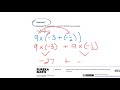
Multiplication and Properties of Numbers

Interactive Video
•
Mathematics
•
6th - 7th Grade
•
Practice Problem
•
Hard

Thomas White
FREE Resource
Read more
10 questions
Show all answers
1.
MULTIPLE CHOICE QUESTION
30 sec • 1 pt
Which property allows you to change the order of numbers in addition without affecting the sum?
Distributive Property
Associative Property
Multiplicative Inverse
Commutative Property
2.
MULTIPLE CHOICE QUESTION
30 sec • 1 pt
When multiplying fractions, why is it beneficial to pair certain numbers together first?
To make the numbers larger
To simplify the calculation
To make the numbers smaller
To avoid using fractions
3.
MULTIPLE CHOICE QUESTION
30 sec • 1 pt
What is the result of multiplying a negative number by another negative number?
A negative number
A positive number
Zero
It depends on the numbers
4.
MULTIPLE CHOICE QUESTION
30 sec • 1 pt
How do you apply the distributive property to a mixed number?
Ignore the fraction part
Convert the mixed number to an improper fraction
Multiply the whole number and fraction separately
Add the whole number and fraction first
5.
MULTIPLE CHOICE QUESTION
30 sec • 1 pt
What is the first step in converting a division problem into a multiplication problem?
Subtract the numbers
Find the reciprocal of the divisor
Multiply the numbers
Add the numbers
6.
MULTIPLE CHOICE QUESTION
30 sec • 1 pt
What is the reciprocal of 2/3?
2/3
1/3
3/2
3/1
7.
MULTIPLE CHOICE QUESTION
30 sec • 1 pt
Why is it useful to rearrange terms in a multiplication problem?
To avoid using fractions
To make the numbers larger
To simplify the calculation
To make the problem look different
Access all questions and much more by creating a free account
Create resources
Host any resource
Get auto-graded reports

Continue with Google

Continue with Email

Continue with Microsoft
or continue with

%20(1).png)
Apple

Others
By signing up, you agree to our Terms of Service & Privacy Policy
Already have an account?


