
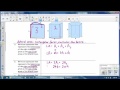
Surface Area and Lateral Area of Prisms

Interactive Video
•
Mathematics
•
6th - 8th Grade
•
Practice Problem
•
Hard
Thomas White
FREE Resource
Read more
5 questions
Show all answers
1.
MULTIPLE CHOICE QUESTION
30 sec • 1 pt
What is a right prism characterized by?
It has no bases and lateral faces that are hexagons.
It has two congruent bases and lateral faces that are rectangles.
It has two congruent bases and lateral faces that are triangles.
It has a single base and lateral faces that are circles.
2.
MULTIPLE CHOICE QUESTION
30 sec • 1 pt
How is the lateral area of a right triangular prism calculated?
By adding the areas of the triangular bases.
By subtracting the base area from the total surface area.
By summing the areas of the rectangular lateral faces.
By multiplying the perimeter of the base by the height.
3.
MULTIPLE CHOICE QUESTION
30 sec • 1 pt
What does the expression A + B + C represent in the context of a right triangular prism?
The total surface area of the prism.
The volume of the prism.
The height of the prism.
The perimeter of the triangular base.
4.
MULTIPLE CHOICE QUESTION
30 sec • 1 pt
What is the formula for the surface area of a square pyramid?
Sum of the base area and four times the area of one lateral triangle.
Sum of the base area and the volume of the pyramid.
Twice the base area plus the perimeter.
Four times the base area plus the height.
5.
MULTIPLE CHOICE QUESTION
30 sec • 1 pt
How do you find the lateral area of a right rectangular prism?
By adding the areas of the two bases.
By subtracting the base area from the total surface area.
By multiplying the base area by the height.
By multiplying the perimeter of the base by the height.
Access all questions and much more by creating a free account
Create resources
Host any resource
Get auto-graded reports

Continue with Google

Continue with Email

Continue with Microsoft
or continue with

%20(1).png)
Apple

Others
By signing up, you agree to our Terms of Service & Privacy Policy
Already have an account?

