
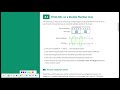
Ratios and Double Number Lines

Interactive Video
•
Mathematics, Science, Other
•
4th - 5th Grade
•
Practice Problem
•
Hard

Thomas White
FREE Resource
Read more
10 questions
Show all answers
1.
MULTIPLE CHOICE QUESTION
30 sec • 1 pt
What was the ratio of drink mix to water in one batch?
4 teaspoons of drink mix to 1 cup of water
4 teaspoons of drink mix to 2 cups of water
2 teaspoons of drink mix to 1 cup of water
8 teaspoons of drink mix to 2 cups of water
2.
MULTIPLE CHOICE QUESTION
30 sec • 1 pt
How many teaspoons of drink mix are needed for a double batch?
8 teaspoons
10 teaspoons
6 teaspoons
4 teaspoons
3.
MULTIPLE CHOICE QUESTION
30 sec • 1 pt
Why are 4:1 and 12:3 considered equivalent ratios?
Both ratios have the same sum
Both ratios are multiples of the same numbers
Both ratios are prime numbers
Both ratios have the same difference
4.
MULTIPLE CHOICE QUESTION
30 sec • 1 pt
What is a key difference between discrete diagrams and double number line diagrams?
Discrete diagrams use pictures, while double number lines use numbers
Discrete diagrams are easier to draw
Discrete diagrams are more accurate
Double number lines are less flexible
5.
MULTIPLE CHOICE QUESTION
30 sec • 1 pt
How many teaspoons of drink mix are needed for three cups of water?
12 teaspoons
10 teaspoons
14 teaspoons
8 teaspoons
6.
MULTIPLE CHOICE QUESTION
30 sec • 1 pt
What number should be in the empty box for five cups of water on the double number line?
28
16
20
24
7.
MULTIPLE CHOICE QUESTION
30 sec • 1 pt
What is the benefit of using a double number line diagram?
It is more colorful
It allows for easier scaling of quantities
It uses fewer numbers
It is simpler to draw
Access all questions and much more by creating a free account
Create resources
Host any resource
Get auto-graded reports

Continue with Google

Continue with Email

Continue with Microsoft
or continue with

%20(1).png)
Apple

Others
Already have an account?

