
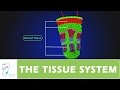
Vascular Bundles and Ground Tissue

Interactive Video
•
Biology
•
9th - 10th Grade
•
Practice Problem
•
Hard

Patricia Brown
FREE Resource
Read more
8 questions
Show all answers
1.
MULTIPLE CHOICE QUESTION
30 sec • 1 pt
Which of the following is NOT a part of the ground tissue system?
Collenchyma
Epidermis
Parenchyma
Sclerenchyma
2.
MULTIPLE CHOICE QUESTION
30 sec • 1 pt
What is the ground tissue in leaves commonly called?
Cortex
Mesophyll
Medullary rays
Cambium
3.
MULTIPLE CHOICE QUESTION
30 sec • 1 pt
What complex tissues make up the vascular tissue system?
Parenchyma and Collenchyma
Xylem and Phloem
Sclerenchyma and Epidermis
Cortex and Mesophyll
4.
MULTIPLE CHOICE QUESTION
30 sec • 1 pt
In dicotyledons, what allows vascular bundles to form secondary tissues?
Conjoined arrangement
Radial arrangement
Absence of cambium
Presence of cambium
5.
MULTIPLE CHOICE QUESTION
30 sec • 1 pt
Why are vascular bundles in monocotyledons referred to as closed?
They are radial
They form secondary tissues
They lack cambium
They have cambium
6.
MULTIPLE CHOICE QUESTION
30 sec • 1 pt
How are xylem and phloem arranged in a radial vascular bundle?
On the same radius
Only on the outer side
In a conjoined manner
In an alternate manner on different radii
7.
MULTIPLE CHOICE QUESTION
30 sec • 1 pt
In conjoined vascular bundles, where is the phloem typically located?
On the inner side of xylem
On the outer side of xylem
Between xylem layers
Above the xylem
Access all questions and much more by creating a free account
Create resources
Host any resource
Get auto-graded reports

Continue with Google

Continue with Email

Continue with Classlink

Continue with Clever
or continue with

Microsoft
%20(1).png)
Apple

Others
Already have an account?

