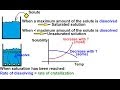
Solubility and Crystallization Concepts

Interactive Video
•
Chemistry
•
9th - 10th Grade
•
Practice Problem
•
Hard

Patricia Brown
FREE Resource
Read more
10 questions
Show all answers
1.
MULTIPLE CHOICE QUESTION
30 sec • 1 pt
What is the term used when a solution can no longer dissolve additional solute?
Unsaturated
Saturated
Diluted
Concentrated
2.
MULTIPLE CHOICE QUESTION
30 sec • 1 pt
What happens to the rate of dissolving and crystallization at saturation?
Both rates increase
Dissolving stops completely
Crystallization stops completely
Both rates become equal
3.
MULTIPLE CHOICE QUESTION
30 sec • 1 pt
What is the term for the process where dissolved solute returns to a solid state?
Condensation
Evaporation
Crystallization
Dissolution
4.
MULTIPLE CHOICE QUESTION
30 sec • 1 pt
What is required for crystallization to occur?
High temperature
Calm conditions
Increased agitation
High pressure
5.
MULTIPLE CHOICE QUESTION
30 sec • 1 pt
How does temperature generally affect the solubility of most compounds?
Solubility decreases
Solubility remains constant
Solubility increases
Solubility fluctuates
6.
MULTIPLE CHOICE QUESTION
30 sec • 1 pt
Which of the following compounds is an exception to the general rule of solubility increase with temperature?
Potassium nitrate
Lithium sulfate
Calcium carbonate
Sodium chloride
7.
MULTIPLE CHOICE QUESTION
30 sec • 1 pt
Which ion is mentioned as forming a structured arrangement with water molecules, affecting solubility?
Nitrate ion
Carbonate ion
Chloride ion
Sulfate ion
Access all questions and much more by creating a free account
Create resources
Host any resource
Get auto-graded reports

Continue with Google

Continue with Email

Continue with Classlink

Continue with Clever
or continue with

Microsoft
%20(1).png)
Apple

Others
Already have an account?
Similar Resources on Wayground

6 questions
Deep-Frying and Ice: A Dangerous Combination
Interactive video
•
9th - 10th Grade
11 questions
Weather Station Models Quiz
Interactive video
•
9th - 10th Grade
11 questions
Coral Reefs and Heat Stress
Interactive video
•
9th - 10th Grade
11 questions
The Science and Imagination of Human Flight
Interactive video
•
9th - 10th Grade
6 questions
Understanding Roman Numerals in Ionic Compounds
Interactive video
•
9th - 10th Grade
11 questions
Understanding Avogadro's Number and the Mole
Interactive video
•
9th - 10th Grade
11 questions
Rocket Propellant Chemistry Quiz
Interactive video
•
9th - 10th Grade
6 questions
Physics of Waves and Resonance Quiz
Interactive video
•
9th - 10th Grade
Popular Resources on Wayground
15 questions
Fractions on a Number Line

Quiz
•
3rd Grade
20 questions
Equivalent Fractions
Quiz
•
3rd Grade
25 questions
Multiplication Facts
Quiz
•
5th Grade
22 questions
fractions
Quiz
•
3rd Grade
20 questions
Main Idea and Details
Quiz
•
5th Grade
20 questions
Context Clues
Quiz
•
6th Grade
15 questions
Equivalent Fractions
Quiz
•
4th Grade
20 questions
Figurative Language Review
Quiz
•
6th Grade
Discover more resources for Chemistry
20 questions
Types of Chemical Reactions
Quiz
•
9th - 12th Grade
20 questions
Energy Transformations
Quiz
•
9th - 12th Grade
20 questions
Periodic Table & Trends
Quiz
•
10th Grade
20 questions
Periodic Trends
Quiz
•
10th Grade
24 questions
Identifying Types of Chemical Reactions
Quiz
•
10th - 12th Grade
20 questions
Naming & Writing Chemical Formulas
Quiz
•
10th Grade
20 questions
Atomic Structure
Quiz
•
10th - 12th Grade
10 questions
Identifying Types of Chemical Reactions
Interactive video
•
6th - 10th Grade