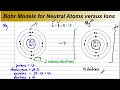
Valence Electrons and Atomic Structure

Interactive Video
•
Chemistry
•
9th - 10th Grade
•
Practice Problem
•
Hard

Patricia Brown
FREE Resource
Read more
10 questions
Show all answers
1.
MULTIPLE CHOICE QUESTION
30 sec • 1 pt
What is the primary purpose of Bohr models?
To determine the atomic mass of elements
To visualize the arrangement of electrons in an atom
To predict the color of an element
To calculate the number of protons in an atom
2.
MULTIPLE CHOICE QUESTION
30 sec • 1 pt
How many electrons does a neutral magnesium atom have?
16
12
10
14
3.
MULTIPLE CHOICE QUESTION
30 sec • 1 pt
What happens to magnesium when it loses its two valence electrons?
It remains neutral
It becomes a positive ion
It becomes a negative ion
It gains two more electrons
4.
MULTIPLE CHOICE QUESTION
30 sec • 1 pt
What are valence electrons responsible for?
Determining the number of protons
Determining the color of an element
Determining the physical and chemical properties of an element
Determining the atomic mass
5.
MULTIPLE CHOICE QUESTION
30 sec • 1 pt
How many valence electrons does chlorine have in its neutral state?
8
7
6
5
6.
MULTIPLE CHOICE QUESTION
30 sec • 1 pt
What change occurs when chlorine becomes a chloride ion?
It loses an electron
It gains an electron
It gains a proton
It loses a proton
7.
MULTIPLE CHOICE QUESTION
30 sec • 1 pt
What is the charge of a magnesium ion after losing two electrons?
1-
2-
1+
2+
Access all questions and much more by creating a free account
Create resources
Host any resource
Get auto-graded reports

Continue with Google

Continue with Email

Continue with Classlink

Continue with Clever
or continue with

Microsoft
%20(1).png)
Apple

Others
Already have an account?
Similar Resources on Wayground

8 questions
Aluminum and Sulfite Compounds
Interactive video
•
9th - 10th Grade
8 questions
Balancing Chemical Equations Concepts
Interactive video
•
9th - 10th Grade
7 questions
Oxygen Gas and Electrolytes Concepts
Interactive video
•
9th - 10th Grade
7 questions
Solubility and Properties of Ammonium Iodide
Interactive video
•
9th - 10th Grade
6 questions
C2H4 Non-Polarity and Structure
Interactive video
•
9th - 10th Grade
6 questions
Balancing Chemical Equations for AgCl
Interactive video
•
9th - 10th Grade
8 questions
Compounds of Alkali Metals
Interactive video
•
9th - 10th Grade
8 questions
Polyatomic Ions and Cadmium Compounds
Interactive video
•
9th - 10th Grade
Popular Resources on Wayground
7 questions
History of Valentine's Day
Interactive video
•
4th Grade
15 questions
Fractions on a Number Line

Quiz
•
3rd Grade
20 questions
Equivalent Fractions
Quiz
•
3rd Grade
25 questions
Multiplication Facts
Quiz
•
5th Grade
22 questions
fractions
Quiz
•
3rd Grade
15 questions
Valentine's Day Trivia
Quiz
•
3rd Grade
20 questions
Main Idea and Details
Quiz
•
5th Grade
20 questions
Context Clues
Quiz
•
6th Grade
Discover more resources for Chemistry
25 questions
Unit 8 Stoichiometry Review
Quiz
•
10th Grade
20 questions
Types of Chemical Reactions
Quiz
•
9th - 12th Grade
19 questions
Stoichiometry, Limiting Reactants, and Percent Yield
Quiz
•
10th Grade
10 questions
Formative 3BD: Ionic Bonds
Quiz
•
9th Grade
15 questions
Balancing Chemical Equations
Quiz
•
10th - 12th Grade
20 questions
Naming & Writing Chemical Formulas
Quiz
•
10th Grade
10 questions
Identifying types of reactions
Quiz
•
9th - 12th Grade
20 questions
Periodic Trends
Quiz
•
10th Grade