
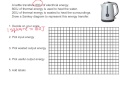
Understanding Sankey Diagrams

Interactive Video
•
Physics
•
9th - 10th Grade
•
Practice Problem
•
Hard

Patricia Brown
FREE Resource
Read more
10 questions
Show all answers
1.
MULTIPLE CHOICE QUESTION
30 sec • 1 pt
What is the main purpose of this video?
To explain the history of Sankey diagrams
To teach how to draw a perfect Sankey diagram
To discuss the advantages of Sankey diagrams
To compare different types of energy diagrams
2.
MULTIPLE CHOICE QUESTION
30 sec • 1 pt
Which component of a Sankey diagram represents the energy being put into the system?
Output energy
Input energy
Useful energy
Wasted energy
3.
MULTIPLE CHOICE QUESTION
30 sec • 1 pt
In the kettle example, how much electrical energy is transferred?
200 Joules
800 Joules
1000 Joules
600 Joules
4.
MULTIPLE CHOICE QUESTION
30 sec • 1 pt
What is the first step in drawing a Sankey diagram?
Decide on the scales
Add labels
Plot the input energy
Plot the wasted energy
5.
MULTIPLE CHOICE QUESTION
30 sec • 1 pt
How many squares represent 800 Joules of input energy in the example?
8 squares
4 squares
6 squares
10 squares
6.
MULTIPLE CHOICE QUESTION
30 sec • 1 pt
What direction do the arrows for wasted energy point in a Sankey diagram?
To the right
To the left
Upwards
Downwards
7.
MULTIPLE CHOICE QUESTION
30 sec • 1 pt
How many squares represent the useful energy output of 600 Joules?
4 squares
7 squares
5 squares
6 squares
Access all questions and much more by creating a free account
Create resources
Host any resource
Get auto-graded reports

Continue with Google

Continue with Email

Continue with Classlink

Continue with Clever
or continue with

Microsoft
%20(1).png)
Apple

Others
Already have an account?
Similar Resources on Wayground

6 questions
DFM rises 1.81 percent
Interactive video
•
9th - 10th Grade
3 questions
The Most Motivating Science Resources for the Toughest IELTS Topics
Interactive video
•
9th - 10th Grade
2 questions
GCSE Physics - Biofuels #12
Interactive video
•
9th - 10th Grade
2 questions
WGA Awards
Interactive video
•
9th - 10th Grade
8 questions
GCSE Secondary Maths Age 13-17 - Probability & Statistics: Probability - Explained
Interactive video
•
10th - 12th Grade
8 questions
GCSE Secondary Maths Age 13-17 - Algebra: Algebraic Fractions - Explained
Interactive video
•
10th - 12th Grade
6 questions
Die Geschichte vom Suppen-Kaspar - Märchen - Deutsch lernen
Interactive video
•
10th - 12th Grade
Popular Resources on Wayground
15 questions
Fractions on a Number Line

Quiz
•
3rd Grade
20 questions
Equivalent Fractions
Quiz
•
3rd Grade
25 questions
Multiplication Facts
Quiz
•
5th Grade
29 questions
Alg. 1 Section 5.1 Coordinate Plane
Quiz
•
9th Grade
22 questions
fractions
Quiz
•
3rd Grade
11 questions
FOREST Effective communication

Lesson
•
KG
20 questions
Main Idea and Details
Quiz
•
5th Grade
20 questions
Context Clues
Quiz
•
6th Grade
Discover more resources for Physics
10 questions
Exit Check 4.1 - Destructive Processes
Quiz
•
9th Grade
10 questions
Exit Check 4.2 - Constructive Forces
Quiz
•
9th Grade
10 questions
Exit Check 4.3 - Conservation of Momentum
Quiz
•
9th Grade
10 questions
Exit Check 4.4 - Momentum Calculations
Quiz
•
9th Grade
21 questions
EM Spectrum
Quiz
•
6th - 9th Grade
20 questions
Simple Machines and Mechanical Advantage Quiz
Quiz
•
9th Grade
14 questions
Graphs of Motion, Velocity & Acceleration
Quiz
•
8th - 9th Grade
21 questions
PE & KE Practice
Quiz
•
8th - 11th Grade