
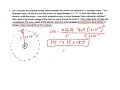
Electric Potential Energy and Kinetic Energy

Interactive Video
•
Physics
•
9th - 10th Grade
•
Practice Problem
•
Hard

Patricia Brown
FREE Resource
Read more
10 questions
Show all answers
1.
MULTIPLE CHOICE QUESTION
30 sec • 1 pt
What is the assumed trajectory of the electron around the proton in this model?
Elliptical
Circular
Linear
Random
2.
MULTIPLE CHOICE QUESTION
30 sec • 1 pt
What is the approximate distance between the proton and electron in a hydrogen atom?
5.3 x 10^-11 meters
1.6 x 10^-19 meters
9 x 10^9 meters
4.35 x 10^-18 meters
3.
MULTIPLE CHOICE QUESTION
30 sec • 1 pt
Which constant is used to calculate the electric potential energy between two charged particles?
Boltzmann's constant
Gravitational constant
Planck's constant
Coulomb's constant
4.
MULTIPLE CHOICE QUESTION
30 sec • 1 pt
How is the electric potential energy between the proton and electron expressed in electron volts?
1.6 eV
13.6 eV
27.2 eV
4.35 eV
5.
MULTIPLE CHOICE QUESTION
30 sec • 1 pt
What assumption is made about the proton when calculating the kinetic energy of the electron?
The proton is absent
The proton is stationary
The proton is moving
The proton is oscillating
6.
MULTIPLE CHOICE QUESTION
30 sec • 1 pt
What is the relationship between the kinetic energy and potential energy in circular motion?
Kinetic energy is half the potential energy
Kinetic energy is double the potential energy
Kinetic energy is unrelated to potential energy
Kinetic energy is equal to the potential energy
7.
MULTIPLE CHOICE QUESTION
30 sec • 1 pt
In the context of circular motion, what force is responsible for the electron's trajectory?
Nuclear force
Gravitational force
Magnetic force
Coulomb force
Access all questions and much more by creating a free account
Create resources
Host any resource
Get auto-graded reports

Continue with Google

Continue with Email

Continue with Classlink

Continue with Clever
or continue with

Microsoft
%20(1).png)
Apple

Others
Already have an account?

